

When you select high-volume, well-vetted swimming pools with incentives, properly handle impermanent loss, and diversify your positions, offering liquidity will be a beautiful supply of passive earnings within the DeFi ecosystem. Nonetheless, it’s not with out threat: it’s worthwhile to perceive the mechanisms, fastidiously choose your positions, and carefully monitor them.
DeFi describes monetary companies created on and operated through blockchain. It’s an already impactful market (with a complete quantity of $14.0 billion) that stands behind lending and borrowing platforms, decentralized exchanges, staking, and, in fact, buying and selling.
However on this planet of DeFi, to help buying and selling exercise, the ecosystem depends on liquidity swimming pools. With out swimming pools of tokens locked in good contracts, DEXs (decentralized exchanges) would lack the depth and responsiveness wanted for affordable swaps.
Whole Worth Locked (TVL) in liquidity swimming pools has grown yr by yr as extra people consider in decentralized markets and understand the value of offering market liquidity so as to attain minimal slippage, environment friendly value discovery, and fixed buying and selling.
What Are Liquidity Swimming pools: Definition & Objective
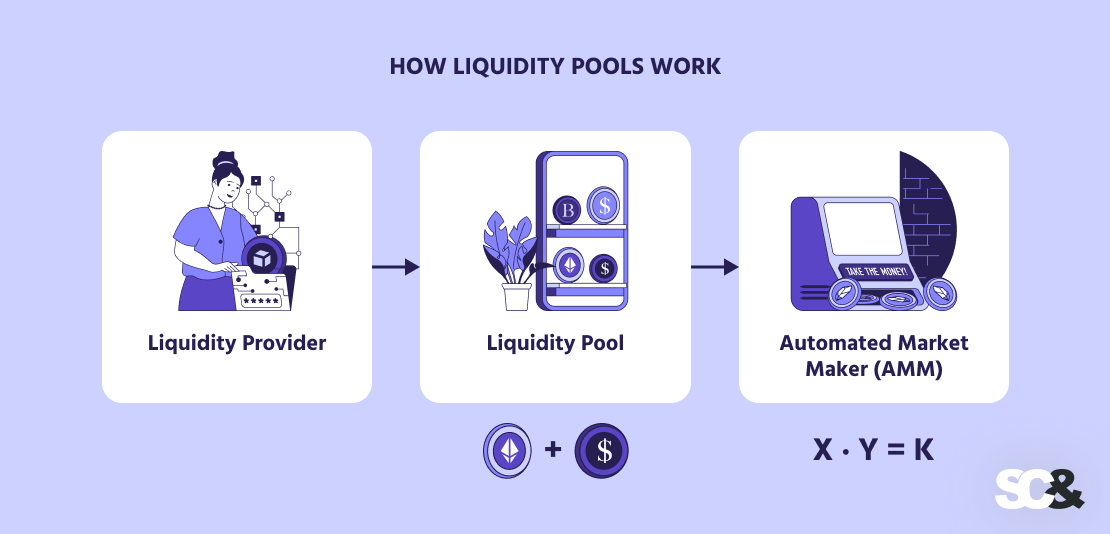
Liquidity swimming pools are one of many foundational innovations of decentralized finance (DeFi). In easy phrases, a liquidity pool consists of crypto tokens locked inside a wise contract that enables customers to commerce, lend, or borrow belongings without having intermediaries or order books.
In centralized exchanges (Binance or Coinbase), trades happen when a purchaser’s order meets a vendor’s order. However within the decentralized area, there’s no central authority to handle the matching course of.
As an alternative, liquidity swimming pools substitute order books with a pool of tokens which might be at all times accessible for buying and selling. Costs are routinely decided by mathematical formulation often known as Automated Market Makers (AMMs) — just like the well-known x · y = ok mannequin pioneered by Uniswap.
Individuals who provide tokens to those swimming pools are known as liquidity suppliers (LPs). They deposit their belongings (in pairs, corresponding to ETH and USDC) right into a pool for others to commerce towards.
Every commerce within the pool generates charges, a portion of which fits to LPs. Basically, they act as market makers, offering liquidity in change for rewards.
Liquidity swimming pools, by the way in which, energy rather more than mere token swaps. In addition they function the spine for yield farming, decentralized lending, artificial asset creation, and cross-chain liquidity transfers — making them an indispensable part of practically each DeFi protocol right this moment.
Key Ideas & Mechanics
Now that we’ve lined what decentralized liquidity swimming pools are, let’s discuss how they really work and what key ideas it’s best to know earlier than getting began with one.
LP Tokens (Share Illustration)
Once you deposit tokens right into a liquidity pool, you get LP tokens in return that symbolize your share of the pool. Once you determine to withdraw your cash, you’ll swap out your LP tokens in your share of the pool belongings, in addition to for any buying and selling charges you earned within the course of.
Incomes Charges
Each time a person swaps tokens by way of a pool, they pay a small buying and selling fee (e.g., 0.3%). That charge doesn’t go to the platform — it’s divided between all of the liquidity suppliers. So, the extra trades that occur in a pool and the bigger your share, the extra you earn.
Impermanent Loss
One of the vital issues to grasp is impermanent loss. It occurs when the costs of the tokens in your pool change in comparison with whenever you first added them.
As a result of AMMs routinely rebalance the pool, you would possibly find yourself with extra of 1 token and fewer of the opposite — and that may typically go away you with much less worth than in the event you had simply held the tokens individually.
The loss is “impermanent” within the sense that it may disappear if costs return to the place they began, however it turns into everlasting the second you withdraw.
For instance:
- Suppose you deposit 1 ETH and 1,000 USDC (ETH = 1,000 USDC) right into a 50/50 pool.
- If ETH doubles in value to 2,000 USDC, arbitrage adjusts the pool in order that you find yourself with ~0.707 ETH + ~1,414 USDC, price ~$2,828 whole.
- However in the event you had held 1 ETH + 1,000 USDC, the entire could be $3,000.
- That ~$172 distinction is an impermanent loss.
Single-Sided vs. Twin Token Provision
Historically, swimming pools require you to deposit two tokens of comparable worth (corresponding to ETH and USDC). That is known as dual-token provision.
Some newer platforms, nonetheless, now present single-sided staking, the place you possibly can stake one kind of token alone. These swimming pools deal with the pairing on their very own, making the method easier, although usually with barely completely different dangers or rewards.
Kinds of Liquidity Swimming pools & AMM Fashions
Not all liquidity swimming pools work the identical manner. Totally different DeFi platforms use completely different AMM fashions. Understanding these fashions permits you to select swimming pools most applicable in your targets and threat tolerance.
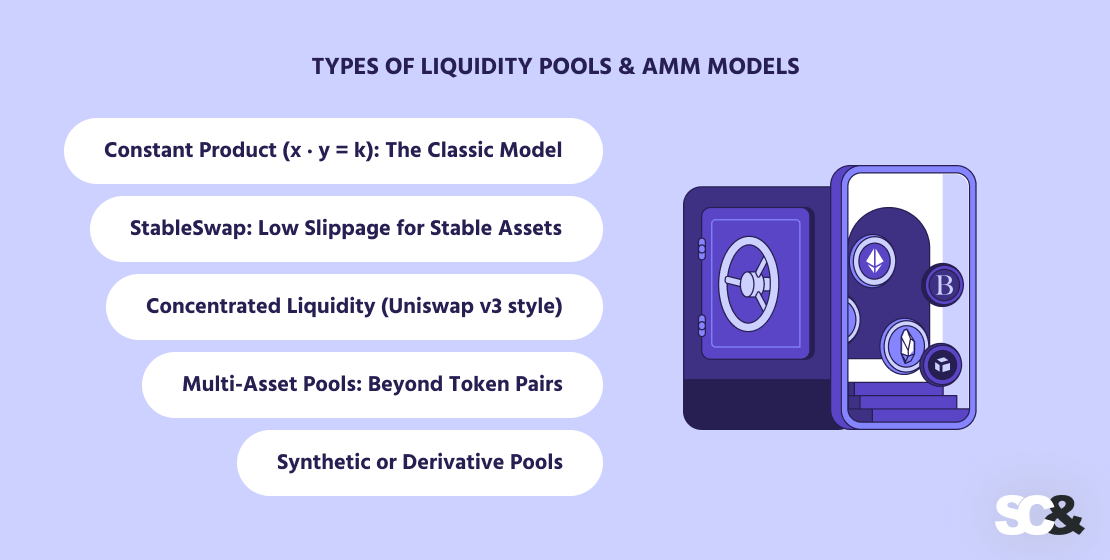
Fixed Product (x · y = ok): The Traditional Mannequin
Fixed product is the most typical AMM components, urged by Uniswap. It retains the product of two token reserves (x and y) equal to a continuing worth (ok).
Merely put, when one token is bought, the value adjusts routinely based on how a lot is remaining within the pool. This is a perfect mannequin for many pairs of tokens, however it would result in larger value slippage when there are large trades or there may be little liquidity.
StableSwap: Low Slippage for Steady Belongings
Utilized by Curve Finance, this mannequin is ideal for buying and selling belongings that keep shut to one another in value, corresponding to stablecoins (USDC, USDT, DAI). The components reduces slippage and impermanent loss, which makes it ideally suited for secure or pegged tokens.
You’ll not get wild yields right here, however the returns are regular and the danger is visibly decrease.
Concentrated Liquidity (Uniswap v3 type)
Popularized by Uniswap v3, concentrated liquidity lets LPs select particular value ranges the place they wish to present liquidity as an alternative of spreading it throughout all costs.
This sort will increase capital effectivity, which means you possibly can earn extra with much less capital, but when the value strikes exterior your chosen vary, your funds will cease producing earnings till the value returns to regular ranges.
Multi-Asset Swimming pools: Past Token Pairs
Some platforms (as an example, Balancer) permit greater than two tokens in a pool (for instance, 80% ETH + 10% WBTC + 10% USDC). These multi-token swimming pools present extra diversification in portfolio administration.
LPs can maintain completely different weights of tokens as an alternative of the identical 50/50 proportion, adjusting their publicity to the market.
Artificial or By-product Swimming pools
Some swimming pools use artificial belongings — tokens that symbolize different belongings or mirror their worth (e.g., artificial USD or wrapped Bitcoin). These swimming pools permit customers to commerce derivatives or acquire publicity to belongings from different blockchains, with extra potential for yield but in addition greater threat.
What Makes a Liquidity Pool “Good”?
With hundreds of liquidity swimming pools accessible throughout completely different blockchains, they aren’t all price your whereas — or your tokens. A “good” liquidity pool gives a stability between profitability, security, and usefulness. Right here’s what to take a look at earlier than deciding the place to place your funds.
Liquidity & Depth
The full worth locked reveals the entire quantity of funds in a pool. Bigger TVL usually means deeper liquidity, which reduces slippage — the value motion that occurs when giant trades transfer the market.
Deep swimming pools are extra secure, whereas shallow ones can create excessive value swings and better threat for LPs.
Buying and selling Quantity & Price Yield
A pool that’s actively traded generates extra charge earnings for its suppliers. The perfect swimming pools mix robust liquidity with regular buying and selling quantity.
Every swap within the pool incurs a small charge (usually between 0.05% and 0.3%), which will get distributed amongst LPs. The extra buying and selling quantity in a pool, the upper your reward.
Rewards & Incentives
Many DeFi protocols appeal to crypto liquidity suppliers by providing extra rewards, corresponding to governance tokens or bonus emissions, along with buying and selling charges.
Nonetheless, it’s vital to examine the emissions schedule — sure rewards taper over time or require you to lock up your cash for longer intervals.
Danger Elements
Liquidity swimming pools carry just a few dangers you shouldn’t ignore:
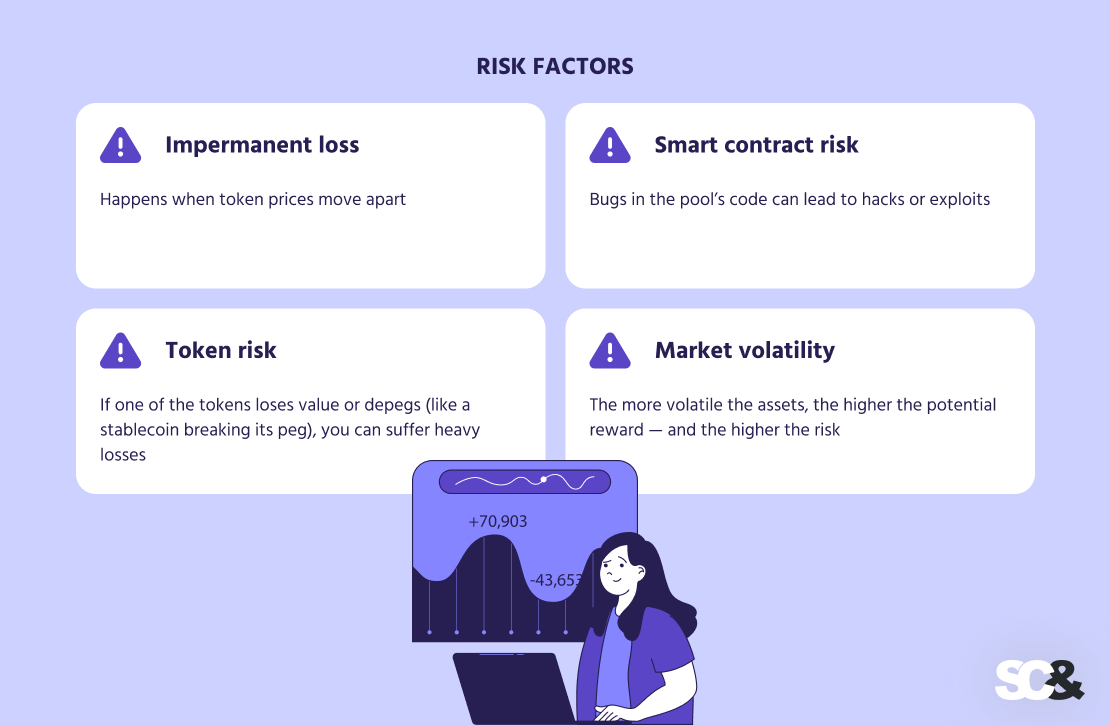
- Impermanent loss: Occurs when token costs transfer aside.
- Good contract threat: Bugs within the pool’s code can result in hacks or exploits.
- Token threat: If one of many tokens loses worth or depegs (like a stablecoin breaking its peg), you possibly can undergo heavy losses.
- Market volatility: The extra risky the belongings, the upper the potential reward — and the upper the danger.
Capital Effectivity & Flexibility
Some AMMs, like Uniswap v3 or Curve, allow you to focus liquidity on particular value ranges, growing capital effectivity (incomes extra with much less capital). Others permit versatile pool weights or automated rebalancing to assist preserve your required publicity with out fixed guide changes.
Usability & Accessibility
No matter how profitable the pool is, if it’s not simple to make use of, it doesn’t matter. Search for platforms with:
- Low fuel charges or availability on Layer 2 networks.
- Easy and totally supportive interfaces that make it simple to deposit and withdraw.
- Cross-chain performance, the place you possibly can change liquidity between ecosystems with out advanced bridging.
High Liquidity Swimming pools / Platforms to Contemplate
Let’s take a look at some well-known crypto exchanges to higher perceive how cryptocurrency liquidity swimming pools work. This checklist is drawn up based mostly on power, yield potential, and threat profile:
Uniswap (Ethereum / Layer 2s / v3 and newer)
Uniswap stays probably the most common decentralized exchanges for liquidity provision. It introduced the fixed product mannequin (x·y = ok) and later moved on to concentrated liquidity with Uniswap v3, which gave suppliers larger management of their capital effectivity.
- Execs: Mature ecosystem, excessive liquidity, loads of yield pairs; with concentrated liquidity, it’s extra capital-efficient.
- Dangers: Gasoline price on Ethereum, vary threat if value strikes exterior your band.
Curve Finance
Curve is fitted to pegged and secure belongings corresponding to USDC, USDT, and DAI. Its StableSwap protocol minimizes slippage and impermanent loss, and therefore it’s most applicable for traders on the lookout for low-risk and secure yield.
- Execs: Extraordinarily low stablecoin pool slippage, very low impermanent loss.
- Dangers: Decrease yields except augmented with additional incentives.
Balancer
Balancer has robust help for multi-asset and customizable pool constructions. It permits you to create swimming pools with as much as eight tokens and assign customized weights (e.g., 80/20 as an alternative of fifty/50), which makes it excellent for customers who wish to construct portfolio-like liquidity methods.
- Execs: Versatile weightings, a number of tokens per pool, good diversification alternatives.
- Dangers: Extra advanced mechanics, probably thinner liquidity in area of interest swimming pools.
PancakeSwap / BNB Chain swimming pools
As the highest DEX on BNB Good Chain (BSC), PancakeSwap gives quick, low-cost buying and selling and all kinds of farming alternatives. Its excessive liquidity and uncomplicated interface make it probably the greatest platforms for rookies.
- Execs: Decrease fuel prices, many incentive applications, good for BNB ecosystem customers.
- Dangers: Greater token threat, much less mature safety file for some initiatives.
The best way to Select the Proper Pool for You
Choosing the proper liquidity pool is a trade-off between threat and acquire. Though excessive APYs could also be tempting, the very best plan of action is to match your decisions together with your targets and threat tolerance.
Begin by assessing your threat tolerance. Low-volatility stablecoin swimming pools like USDC, DAI, or USDT yield constant returns with minimal impermanent loss, however riskier buying and selling pairs like ETH/USDC or BTC/ETH can yield greater charges on the expense of larger threat.
Subsequent, diversify each between swimming pools and platforms to cut back the publicity within the occasion of a token or protocol failure. For instance, cut up your funds between a stablecoin pool on Curve, an ETH pool on Uniswap, and a small portion in a yield farm for further incentives.
Additionally, start with a small funding and watch efficiency. Use analytics instruments like DefiLlama, Zapper, or Uniswap Data to trace TVL, buying and selling quantity, and charges.
Test the platform’s safety and fame. Established protocols, corresponding to Uniswap, Curve, and Balancer, provide audits and lively communities, whereas newer swimming pools will be riskier.
Lastly, put together an exit technique. Don’t be afraid of withdrawing when circumstances change, and be prepared to maneuver funds to better-performing swimming pools.
Step-by-Step: The best way to Be a part of & Earn
Frankly talking, becoming a member of a liquidity pool is straightforward, however it does require a primary understanding of how DeFi platforms work and taking some precautions to ensure the safety of your belongings.
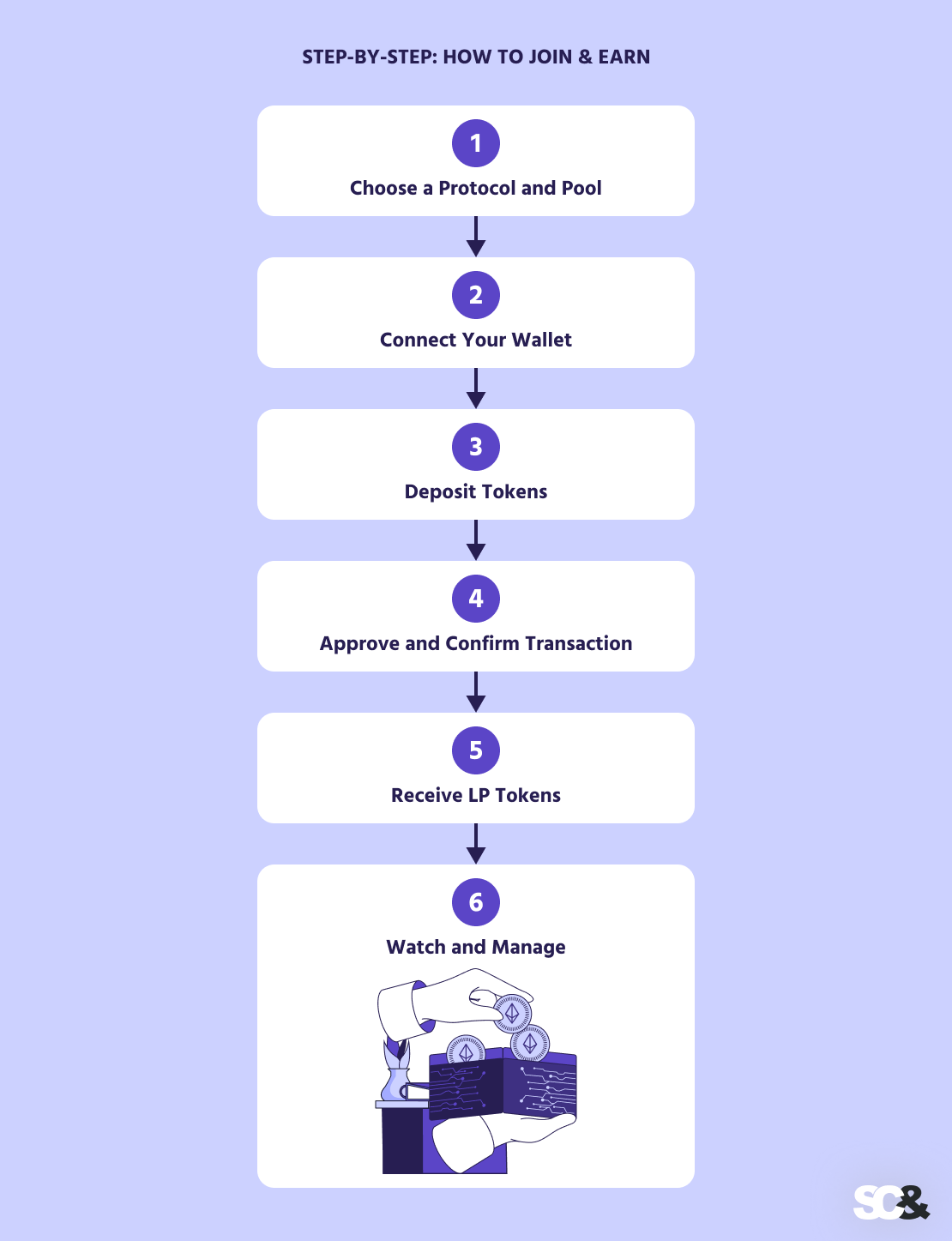
By offering liquidity, you contribute to the protocol’s buying and selling ecosystem and, in flip, obtain a share of charges or extra incentives.
- Select a Protocol and Pool: Begin by deciding on a good platform and a pool that goes in keeping with your targets, be it a stablecoin pair for decrease threat or a risky pair for greater rewards.
- Join Your Pockets: Use a crypto pockets to hook up with the platform. Be sure your pockets has sufficient of the tokens required for the pool.
- Deposit Tokens: Deposit the matching token quantities to the pool. Swimming pools usually require equal worth for each token (e.g., 1 ETH + 1,500 USDC), although sure swimming pools provide single-sided deposits.
- Approve and Verify Transaction: Approve the good contract to entry your tokens and make sure the transaction. This will likely contain paying a community charge (fuel).
- Obtain LP Tokens: As soon as your deposit is confirmed, you’ll obtain LP tokens representing your share of the pool. The tokens entitle you to a share of buying and selling charges and any rewards.
- Watch and Handle: Commonly examine your place for charges earned, impermanent loss, and reward distribution. Use analytics dashboards to comply with efficiency and determine when to withdraw or transfer funds.
How SCAND Can Assist
In DeFi, one small coding mistake can quantity to very large losses. Bugs, safety vulnerabilities, or unaudited good contracts have already price the business billions of {dollars}, which is why high quality good contract improvement and audits are so vital.
At SCAND, we assist DeFi platforms, liquidity suppliers, and blockchain startups safe their methods with end-to-end good contract improvement, auditing, and testing. Our blockchain engineers and safety professionals totally vet each element of your contract — logic, efficiency, compliance — to ensure every little thing works the way in which you need it to earlier than deployment.
We don’t solely detect defects. Our workforce additionally rewrites your contracts to make them extra optimized, less expensive to carry out (gas-efficient), and simpler to replace in the long term.
We stability automated and human testing to detect vulnerabilities, corresponding to reentrancy assaults, logic errors, or poor entry controls which might be often attacked by hackers.
When you’re creating your personal AMM, liquidity pool, or DeFi app, we will even create customized good contracts for you — from liquidity and dynamic charge administration to designing staking or token reward methods.
Superior Methods & Suggestions
After you have got mastered the fundamentals of liquidity provision, there are some superior methods you possibly can experiment with to compound returns and restrict threat.

One among these methods is pool hopping and liquidity migration. Shifting funds from decrease quantity or lower-yielding swimming pools to extra performing ones can optimize returns, and a few platforms promote this with out cashing out.
Then, you should use the LP tokens as collateral to borrow different belongings. This lets you borrow whereas your tokens are nonetheless producing charges within the pool.
As an illustration, you possibly can use borrowed tokens to spend money on one other pool or alternative with out eradicating your preliminary deposit — principally placing your cash to work in two locations without delay.
One various is to make the most of Yearn or Convex crypto liquidity options. They routinely switch your funds from one pool to a different, declare rewards, and reinvest them so as to maximize your whole yield.
It’s as when you have a wise assistant that manages your liquidity so that you simply should not have to manually monitor every little thing.
You may also attempt cross-chain methods, the place you cut up your capital over completely different blockchains. This manner, you get to entry swimming pools with higher rewards or decrease charges. Bridging belongings between chains does include some threat, nonetheless, so solely use trusted and safe bridges.
Lastly, skilled customers make use of hedging and rebalancing to guard their capital. For instance, you possibly can cut up your funding between stablecoin swimming pools (much less dangerous) and risky swimming pools (extra rewarding).
Widespread Errors & Pitfalls to Keep away from
DeFi liquidity provision is worthwhile, but not risk-free. A majority of traders commit basic errors that may price them cash if they don’t take measures.
One of many best errors is ignoring fuel and transaction charges. Transaction charges on a community like Ethereum are usually not negligible and might eat into your earnings in case your funding is small.
One other entice is failing to account for impermanent loss. Even after incomes charges, token value volatility can decrease your web revenue. On this manner, it’s nice to pay attention to this threat and examine your pool frequently.
Others put all of their cash in new or dangerous swimming pools. This method is at all times reckless as a result of new or unaudited protocols can both get hacked or tokens can turn into nugatory in a single day.
Chasing very excessive returns with out consideration of the dangers can also be prevalent. Excessive returns are sometimes preceded by excessive volatility or illiquid markets.
Lastly, not having a withdrawal technique will be detrimental to your positive aspects. Offering liquidity isn’t “set and neglect.” It’s being conscious of when to withdraw your funds and when to switch them to extra promising alternatives to safeguard your funds.
Regularly Requested Questions (FAQs)
What’s a liquidity pool?
A liquidity pool is a group of crypto tokens which might be pooled and locked in a wise contract, which individuals could commerce, lend, or borrow towards. When you contribute tokens to the pool as a crypto liquidity supplier, you get a share of the buying and selling charges.
How do I earn from liquidity swimming pools?
Often, you’re rewarded for staking tokens in a pool. A small charge is taken every time a commerce is executed and shared with all LPs. Swimming pools additionally exist with added rewards, corresponding to governance tokens or bonus yield farming.
What’s impermanent loss?
Impermanent loss is when the value of tokens within the pool adjustments after you deposit them. Such a change in value reduces your total return in the event you had simply saved the tokens. The loss stays everlasting solely whenever you money out your cash.
What are LP tokens?
Basically, LP tokens are your portion of the pool. They enable you get your share of belongings and any withdrawal charges whenever you withdraw. You’ll be able to even stake LP tokens in some swimming pools and get further rewards.
Which swimming pools are most secure for rookies?
Often, the most secure swimming pools are the stablecoin swimming pools, corresponding to USDC/DAI or USDT/USDC. They’ve low volatility, minimal impermanent loss, and regular returns.
How do I select the very best pool?
To begin with, take a look at whole worth locked, buying and selling quantity, charges, rewards, and threat. In apply, you possibly can unfold your funds throughout completely different swimming pools, begin small, and use analytics instruments to look at efficiency.
Can I lose cash in a liquidity pool?
Sure. As with the whole crypto market generally, there are specific dangers. Concerning liquidity swimming pools, these embrace impermanent loss, token value swings, good contract defects, or challenge failures.
How do I get began?
Getting began is fairly easy. Choose a trusted platform and pool, join your pockets, deposit your tokens, get LP tokens, and optionally stake them for further rewards.