Home Blog Page 42

FYAI: Why builders will lead AI transformation throughout the enterprise

0

Builders are main AI adoption—and driving transformation throughout each trade. From writing code to managing functions, they’re utilizing copilots and brokers to speed up supply, cut back handbook effort, and construct with better confidence. Simply as they led automation, builders are actually reshaping buyer experiences and streamlining operations to unlock AI’s full potential. 

On this version of FYAI, a sequence the place we highlight AI tendencies with Microsoft leaders, we hear from Amanda Silver, Company Vice President and Head of Product, Apps, and Brokers. Amanda’s management has formed Microsoft’s evolution towards open-source collaboration, and she or he’s advancing a future the place AI transforms how builders construct, deploy, and iterate at scale to drive steady innovation.

On this Q&A, Amanda shares why developer-led AI adoption issues, how agentic DevOps is redefining workflows, and what leaders can do at present to maximize affect.  

How is the AI panorama altering how developer groups ship the apps companies run on?  

AI is collapsing handoffs throughout the software program lifecycle. DevOps efficiently united construct, take a look at, deploy, and function, however the earlier phases—discovery, necessities, shared imaginative and prescient, and preliminary scaffolding—largely sat exterior that loop. Now copilots can flip pure language concepts into specs and scaffolds, and brokers tackle exams, upgrades, and runtime operations. The result’s a single, sooner cycle from concept to affect: decrease price to iterate, faster transitions, and extra freedom to refine till the product suits the enterprise. Consider it just like the shift to public cloud: earlier than the general public cloud, groups waited weeks to obtain {hardware} and commit capital up entrance; with the cloud, environments spin up in seconds and also you pay just for what you utilize. AI brings that identical elasticity to product definition and supply—eradicating friction on the entrance of the lifecycle and letting groups iterate primarily based on actual suggestions. Put merely: cloud eliminated friction from infrastructure; AI removes friction from intent to implementation.

What are some examples of how AI helps builders re-imagine their each day work?   

AI is popping software program supply into a real idea-to-operate system. For builders, meaning much less time spent on handbook cleanup and extra time centered on artistic, high-impact work. Copilots and brokers now deal with the repetitive, usually invisible duties that used to pile up—like debugging, dependency upgrades, and safety patches. As an alternative of ready for a quarterly “tech debt dash,” agentic DevOps lets groups pay down debt constantly, within the background.  

An ideal instance is how agentic AI is accelerating migration and modernization. Up to now, updating frameworks or shifting to new platforms meant months of planning and handbook fixes. Now, brokers can automate .NET and Java upgrades, resolve breaking adjustments, and even orchestrate large-scale migrations—compressing timelines from months to hours. This isn’t nearly pace; it’s about retaining codebases wholesome and fashionable by default, so builders can deal with constructing new options and enhancing person experiences.  

The online impact: builders spend much less time firefighting and extra time innovating. Technical debt turns into a manageable, ongoing course of—not a looming disaster. And as AI brokers tackle extra of the routine work, groups can function in a steadier circulation state, with more healthy code and sooner supply.  

What does that imply for apps? Are they getting higher? And the way does this affect the function a developer performs?

Apps will get higher as a result of they turn into studying techniques. With AI within the loop, groups shift from ship and hope to steady observe → hypothesize → change → validate cycle centered on constantly refining product–market match. AI will help synthesize telemetry (corresponding to funnels, dropoffs, session replays, and qualitative suggestions), floor the place customers wrestle, suggest adjustments (like copy, circulation, element structure, and suggestions), and might even wire up characteristic flags or experiments to show whether or not a change works. The impact is a dramatic discount in time to studying—and sooner convergence on what customers worth.  

PreAI versus PostAI person interplay  

  • PreAI: Customers navigate dense menus and deep info architectures, scanning screens to search out the one management that does what they want. Each step dangers a useless finish, and context is simple to lose when switching pages or instruments.
  • PostAI: Customers specific intent in pure language (like textual content, speech, or multimodal). The app interprets that intent, retains context, and routes the person to the appropriate knowledge, motion, or workflow—usually composing the UI on the fly (for instance, drafting a type, filtering to the related information, and suggesting the subsequent finest motion). Consider this as shifting from “The place do I click on?” to “Right here’s what I want—do it with me.”  

What adjustments for builders  

  • From web page builders to expertise composers. Devs design intent routers and orchestrations that join fashions, brokers, knowledge, and companies—so the app can reply intelligently to diverse person objectives with out forcing inflexible click on paths.
  • From handbook evaluation to AI-assisted product loops. As an alternative of hand rolled dashboards and advert hoc investigations, AI highlights alternative areas, drafts experiment plans, and opens pull requests with proposed code and config adjustments. Builders evaluation, constrain, and ship—with guardrails.
  • From “debt sprints” to steady modernization. Brokers can preserve the app present—upgrading frameworks (for instance, .NET and Java), repairing dependency drift, patching vulnerabilities, and standardizing pipelines—whereas characteristic work continues. That turns tech debt right into a managed, at all times on workload somewhat than a periodic fireplace drill.   

Backside line: AI tightens the loop between what customers need and what the app turns into. Builders spend much less time on menu wiring and handbook forensics, and extra time defining intent, composing agentic flows, setting success metrics, and supervising protected, measurable change. Apps enhance sooner—not simply because they’re smarter, however as a result of groups can experiment, be taught, and adapt as utilization grows.  

The place do you see Microsoft standing out in a sea of AI competitors?  

Microsoft’s largest differentiator is our means to attach AI brokers to the techniques, knowledge, and workflows that energy actual enterprise. We serve organizations with huge, complicated codebases and deep operational necessities—and our instruments are designed to fulfill them the place they’re. With GitHub, Visible Studio, and Azure AI Foundry, hundreds of thousands of builders can entry the most recent fashions and agentic capabilities straight of their each day workflow, backed by enterprise-grade safety, governance, and accountable AI benchmarks.  

However what really units Microsoft aside is the breadth of integration. AI brokers constructed on our platform can faucet into an enormous ecosystem of enterprise apps, knowledge sources, and operational techniques—whether or not it’s enterprise useful resource planning (ERP), buyer relationship supervisor (CRM), human assets (HR), finance, or customized line-of-business options. By way of open requirements like Mannequin Connector Protocol (MCP) and Agent-to-Agent (A2A), brokers can securely join, orchestrate, and automate throughout these environments, making it attainable to ship outcomes that matter: automating workflows, modernizing legacy techniques, and driving steady enchancment.  

Yina Arenas’s Agent Manufacturing unit sequence exhibits how Microsoft is constructing the blueprint for protected, safe, and dependable AI brokers—from fast prototyping to manufacturing, observability, and real-world use instances. Our platform isn’t nearly constructing brokers; it’s about enabling them to work with the techniques and knowledge that organizations already depend on, so groups can transfer from experiments to enterprise-scale affect.  

On the finish of the day, Microsoft’s benefit is not only scale—it’s the power to make AI brokers really helpful by connecting them to the guts of the enterprise, with the instruments and requirements to do it safely and securely.  

When ought to builders determine which duties to delegate to brokers versus sort out themselves for max affect?  

As my colleague, David Fowler, put it: “People are the UI thread; brokers are the background thread. Don’t block the UI!” Builders ought to deal with the artistic, judgment-driven work—setting intent, making architectural choices, and shaping the product expertise. Brokers excel at dealing with the repetitive, long-running, or cross-cutting duties that may quietly run within the background: code well being, dependency upgrades, telemetry triage, and even scaffolding out options to unblock the clean web page.  

The bottom line is to delegate something that slows down your circulation or distracts from high-impact work. If a activity is routine, latency-tolerant, or simply reversible, let an agent deal with it. If it requires deep context, product judgment, or may basically change the course of your app, preserve it on the human “UI thread.” This manner, builders keep responsive and centered, whereas brokers constantly enhance the codebase and operations in parallel.  

By hanging the appropriate stability, builders can decrease time spent on routine duties and keep centered on the work that strikes merchandise and groups ahead. 

As a result of software program growth already generates the sort of wealthy, structured alerts that AI thrives on. Code and diffs, pull request opinions, take a look at outcomes, construct logs, runtime and efficiency telemetry, difficulty trackers, and deployment outcomes are all labeled, timestamped, and traceable. That makes the dev setting a pure proving floor for utilized machine studying: fashions can be taught from actual work, be evaluated in opposition to goal checks (like exams, linters, and insurance policies), and enhance inside an current suggestions loop (corresponding to Steady Integration and Steady Supply (CI/CD), characteristic flags, and canaries). Briefly, we’ve got the info, the instrumentation, and the validation inbuilt.  

There’s additionally a cultural cause: builders automate away friction—from compilers and construct techniques to model management, CI/CD, containers, and infrastructure as code. Generative AI is the subsequent step in that lineage. It shifts extra work from hand authoring to specifying intent and supervising outcomes: copilots assist with exploration and acceleration; brokers deal with steady code well being, upgrades, and protected, reversible adjustments. Funding flows right here as a result of higher developer expertise maps on to throughput, high quality, and time to worth.  

And sure—the future begins with builders. As dev groups uncover the place AI delivers actual help in their very own workflow, these patterns unfold to the remainder of the enterprise, accelerating how each operate experiments, learns, and ships.  

Empowering builders with AI to ship lasting affect 

We’re coming into a brand new period of software program supply—and it’s agentic, adaptive, and deeply human-centered. With copilots and brokers within the loop, builders are constructing techniques that regularly adapt to enterprise wants. At Microsoft, we’re empowering builders to maneuver from concept to affect sooner by specializing in creativity, product imaginative and prescient, and constructing with reliable AI. 

The truth is, Frontier Corporations are already displaying us what’s attainable. They deal with software program as a dynamic system—refined by way of telemetry, experimentation, and AI-powered perception. And throughout all sorts of organizations, compelling AI use instances are rising—from customer support to software program engineering—setting the tempo for what’s attainable with the most recent AI tooling. 

Able to be taught extra? Uncover assets and instruments to speed up your AI journey: 

Managing Giant Photogrammetry Tasks: Insights from SimActive

0

How scalable workflows, automation, and distributed processing make managing giant photogrammetry initiatives doable.

SimActive CEO Philippe Simard

DRONELIFE spoke with Philippe Simard, co-founder and CEO of SimActive, the Canadian firm behind the Correlator3D photogrammetry suite, to discover probably the most urgent challenges within the aerial mapping business: how one can effectively handle and course of large datasets from large-scale initiatives, generally throughout a number of operations without delay.

Defining “Giant” in Photogrammetry

In relation to photogrammetry, measurement isn’t just a query of geography. “A big photogrammetry venture is primarily outlined by its complete knowledge quantity,” stated Simard. “For drone-based initiatives, this might contain tens of hundreds of 60-megapixel pictures, leading to terabytes of uncooked knowledge.” Whereas geographic scope contributes, he famous that it’s the information measurement that actually dictates the extent of complexity and useful resource demand.

Managing Giant Photogrammetry Tasks: Insights from SimActiveManaging Giant Photogrammetry Tasks: Insights from SimActive

The place Bottlenecks Start

In line with Simard, the most important slowdowns usually seem in the course of the processing stage, not in flight operations. “Knowledge acquisition is mostly linear, involving a number of missions over days to cowl giant areas,” he defined. “The actual problem is dealing with large datasets—simply the transfers alone can turn out to be a bottleneck if not managed effectively.”

A typical mistake, he stated, is making an attempt to course of the whole lot in a single go. “Customers usually try and course of all knowledge in a single batch utilizing software program not optimized for scale, resulting in exponentially longer processing occasions and crashes,” stated Simard. He added that many groups additionally misjudge {hardware} wants, investing closely in high-end techniques with out addressing core software program inefficiencies.

Scalable Options and Sensible Workflows

For groups engaged on giant or concurrent initiatives, Simard advises beginning with software program designed to deal with large workloads. “Our Correlator3D suite handles huge datasets on commonplace {hardware},” he stated. The important thing, he defined, is to divide initiatives into manageable tiles. “Breaking a venture into tiled subparts accelerates processing and simplifies high quality checks, making certain sooner turnaround whereas sustaining accuracy.”

{Hardware} stays a key consider scaling. “Storage pace is commonly the bottleneck in data-intensive duties,” stated Simard. “We advise utilizing PCI Specific NVMe SSDs for supply imagery, since every photograph could also be accessed a number of occasions.” For bigger setups, he recommends pairing SSDs for inputs with HDDs or high-speed networks, like 10-Gigabit techniques, to steadiness efficiency and value.

Scaling with Distributed and Cloud Processing

SimActive’s method to scaling is constructed on distributed processing—maximizing the assets groups have already got. “Correlator3D mechanically detects obtainable PCs and distributes venture chunks, attaining near-linear speedups,” Simard stated. “As an example, 5 machines can scale back processing time by about 4.6x.” This method permits organizations to extend throughput with out heavy funding in new {hardware}.

Cloud processing, he added, is changing into an more and more viable choice. “Platforms like AWS or Azure permit customers to scale computing energy on demand,” stated Simard. Importing terabytes of images can nonetheless be time-consuming, however for groups already delivering outcomes by way of the cloud, “it integrates seamlessly, turning potential drawbacks into workflow benefits.”

Automation and High quality Management Throughout A number of Tasks

Automation is one other main consider managing a number of giant initiatives concurrently. “Automation permits 24/7 operations by scripting that chains processes like aerial triangulation and orthomosaic technology,” Simard stated. Correlator3D helps electronic mail notifications for distant monitoring, permitting groups to scale back guide work, decrease errors, and deal with extra initiatives with out proportional employees will increase.

Nonetheless, effectivity means little with out consistency. “Groups ought to set up documented protocols with standardized checks, reminiscent of verifying accuracy metrics,” stated Simard. Complete coaching, he added, helps be certain that all group members adhere to uniform high quality management practices. Instruments inside Correlator3D, reminiscent of enhancing and QC options, streamline evaluation processes and scale back the danger of oversight.

Classes from the Discipline

A notable instance of large-scale photogrammetry in motion got here after a twister struck Selma, Alabama, in 2023. The Alabama Division of Transportation captured greater than 18,000 drone photos to help in restoration efforts. “Utilizing Correlator3D’s distributed processing, they generated maps and commenced supply inside 24 hours,” stated Simard. “It demonstrated how preparation, scalable software program, and modular workflows allow speedy, efficient responses—even beneath emergency situations.”

The Way forward for Managing Giant Datasets

As drone, satellite tv for pc, and sensor expertise advances, the amount of information generated will proceed to develop. “Multi-camera techniques are producing immense knowledge volumes,” stated Simard. “Mission administration will rely extra on automation and distributed or cloud processing to maintain tempo.”

The evolution, he believes, will allow groups to ship more and more advanced datasets shortly and precisely—turning what was as soon as a logistical problem right into a strategic benefit.

Learn extra:


A Nanoparticle Drug Triggered the Mind to Quickly Flush Out Poisonous Alzheimer’s Proteins in Mice

0

The mind is sort of a metropolis inside a fortress.

Its mobile inhabitants usually hum alongside of their every day routines. Neurons ship out {the electrical} alerts underlying reminiscence and cognition. Supporting cells present vitamins and fine-tune neural alerts. Immune cells hold a watch out for an infection and different risks. A liquid bathtub washes away poisonous proteins.

Surrounding the town is a tight-knit mobile wall referred to as the blood-brain barrier. The barrier blocks potential invaders, like infectious illnesses swimming within the blood. However it’s removed from impenetrable. The barrier selectively chooses which molecules go into the mind and which exit.

In Alzheimer’s illness, poisonous clumps of a protein referred to as amyloid-beta construct up inside neurons. Scientists have lengthy tried to neutralize them, however most makes an attempt have failed. This month, a new examine turned to the blood-brain barrier to rid the mind of amyloid proteins utilizing cleverly designed nanoparticles.

In mice modeling Alzheimer’s illness, three photographs tricked the barrier into trafficking the poisonous proteins out of the mind and into the bloodstream, the place they have been quickly destroyed. In simply an hour, the remedy slashed amyloid-beta ranges in half. The mice additionally higher remembered areas—form of like the place you final parked your automotive—with results lasting for six months.

“The long-term impact comes from restoring the mind’s vasculature,” mentioned examine creator Giuseppe Battaglia in a press launch. “What’s exceptional is that our nanoparticles act as a drug and appear to activate a suggestions mechanism that brings this clearance pathway again to regular ranges.”

Blocked Drain

The buildup of amyloid-beta protein clumps is a trademark of Alzheimer’s. They enhance in quantity over time and, like poisonous waste, pollute close by cells. Whether or not the proteins trigger the illness remains to be debated. However scientists typically agree that their presence worsens mind operate and degrades reminiscence and cognition over time.

Potential Alzheimer’s remedies have focused these clumps for many years. Most failed throughout medical trials. Researchers deserted initially promising interventions as a result of lack of efficacy or uncomfortable side effects—incomes the makes an attempt the “graveyard of goals.”

Regardless of these troubles and with a lot controversy, the US Meals and Drug Administration accredited a drug in 2024 to sort out amyloid buildup in sufferers struggling delicate levels of the illness. The remedy, a kind of remedy referred to as anti-amyloid remedy, reduces ranges of the protein, and sufferers confirmed some cognitive enchancment. However the drug additionally induced severe uncomfortable side effects, together with mind bleeds and stroke-like signs in some individuals. It additionally requires repeated dosing at a hefty price ticket.

As a substitute of immediately focusing on amyloid-beta within the mind, what if we are able to flush it out?

Molecular Charon

The mind has a number of cleaning programs. Every cell has an acidic bubble to interrupt down proteins, fat, and different parts the cell deems poisonous. The blood-brain barrier additionally ferries probably harmful proteins out of the mind for the physique to neutralize.

This course of breaks down in Alzheimer’s. The barrier is fabricated from tightly knitted cells like a brick wall, with protein receptors are dotted alongside its floor. These molecules shuttle cargo between the mind and bloodstream. Not all proteins make it by means of. Some are directed to the barrier’s acid bubble, and others are chopped up by the cell’s recycling manufacturing facility. Amyloid-beta clogs each waste disposable services and destroys the barrier from inside.

Earlier research discovered a protein transporter that may seize amyloid-beta proteins and probably drag them into the bloodstream. Referred to as lipoprotein receptor-related protein 1 (LRP1), the molecule retains the blood-brain barrier wholesome and shuttles the poisonous protein out of the mind.

Impressed by LRP1, the crew engineered a nanoparticle to assist it work extra successfully. However the transporter is finicky. Usually, it carries proteins throughout the blood-brain barrier. However in Alzheimer’s, it’s typically rerouted to the cell’s acid bubble and destroyed. Because the illness progresses, LRP1 dwindles, inflicting the mind to battle with waste disposal.

The crew’s nanoparticles rejuvenate the sluggish transporters. Nanoparticles are typically used to hold genetic remedies and aren’t therapies. However right here, their form interacts with the transporter.

The crew designed the nanoparticles to incorporate a number of “hooks” that work together with LRP1 in extremely particular methods, corresponding to shifting its routes throughout the blood-brain barrier whereas carrying cargo, relatively than drifting into self-destruction within the cell’s acid baths.

The trick paid off.

The crew gave mice modeling Alzheimer’s illness three injections of the nanoparticle—it slashed ranges of amyloid-beta. “Just one hour after the injection we noticed a discount of 50-60 % in Aβ [amyloid-beta] quantity contained in the mind,” mentioned examine creator Junyang Chen.

Reactivating transcytosis—the method of shuttling proteins throughout the blood-brain barrier—was solely partly accountable for the advance. The remedy additionally restored the well being of the barrier itself, rejuvenating its construction and including extra protein shuttles.

This enchancment correlated with higher reminiscence and cognition. The crew gave mice with human Alzheimer’s genes the photographs once they have been roughly middle-aged and examined their reminiscence six months later—properly into outdated age. In a single take a look at, the seniors simply navigated a milky, watery maze utilizing visible cues. People who didn’t obtain the remedy swam round aimlessly.

“We expect [the nanoparticles work] like a cascade,” mentioned Battaglia. “When poisonous species corresponding to amyloid-beta accumulate, illness progresses. However as soon as the vasculature is ready to operate once more, it begins clearing Aβ [amyloid-beta] and different dangerous molecules, permitting the entire system to recuperate its stability.”

Handled aged mice additionally appeared happier. Somewhat than languishing, they constructed nests out of obtainable supplies—corresponding to cotton—and bounced as much as get a sugary water deal with when supplied. They cared about fixing their houses and having fun with treats, like youthful mice, which factors to the next “high quality of life,” wrote the crew.

To state the apparent, mice usually are not folks. Loads of promising Alzheimer’s therapies in mice have faltered in medical trials. And though we share an identical blood-brain barrier with the critters, their molecular make-up doesn’t precisely map to ours. However the nanoparticle idea provides to an more and more various financial institution of strategies that don’t immediately goal amyloid-beta with antibodies.

 “The blood-brain barrier isn’t merely an impediment to be bypassed however a dynamic and reparable interface whose dysfunction might be therapeutically reversed,” wrote the crew. The outcomes recommend we are able to transfer “past the paradigm of ‘overcoming the barrier’ in the direction of ‘repairing the barrier.’”

Former unicorn staff to launch German startup Afori with €4 million to carry AI-powered effectivity to insurance coverage brokers

0

Afori, a brand new AI platform purpose-built for insurance coverage brokers out of Berlin, at present introduced its official launch out of stealth alongside the closing of a €4 million pre-Seed funding spherical.

The spherical was led by Normal Catalyst with participation from Yellow, Booom, insurance coverage trade leaders together with Christopher Lohmann (Founder the Mulberry Ventures, ex-CEO HDI and Gothaer), Chris Leifeld (Founder Thinksurance) and Garrett Koehn (CIO CRC), and recognised AI pioneers Mustafa Suleyman (CEO, Microsoft AI), Alex Rinke (Founder & Co-CEO Celonis) and Mehdi Ghissassi (ex-Google DeepMind).

Insurance coverage brokers nonetheless spend the vast majority of their day tied up in administrative work, a burden that’s solely rising heavier with growing regulation,” mentioned Fabian Wesemann, Co-Founder and CEO of Afori. “At Afori, we’ve labored hand-in-hand with brokers to design an answer that speaks their language, understands their processes, and offers them again essentially the most invaluable useful resource of all: time to advise their shoppers.

Afori’s pre-Seed spherical situates the corporate inside a broader wave of European InsurTech and AI-driven automation funding in 2025. A number of startups have attracted investor consideration for making use of AI to insurance coverage workflows – from claims processing to dealer enablement. London’s ClaimSorted raised yesterday €11.4 million to modernise claims dealing with, whereas Paris-based Seyna secured €10 million to develop its broker-dedicated platform. Fellow French startup Orus closed €25 million to develop its SME-focused insurance coverage companies, whereas Denmark’s Leaf raised €1.7 million for AI-powered enterprise insurance coverage and pension recommendation.

Equally, Berlin’s muffintech secured €3.5 million to construct AI instruments for insurers and brokers, a very related parallel given Afori’s broker-centric method.

Collectively, these examples point out a gentle capital stream into specialised, AI-enabled insurance coverage platforms throughout Europe. Afori’s deal with brokerage-specific automation aligns with this development, positioning it as a part of a broader motion to streamline back-office capabilities and improve productiveness inside regulated monetary companies.

Not like generic productiveness instruments, Afori’s AI is skilled on actual dealer use instances and insurance-specific terminology,” added Sergi Banos, Co-founder and CTO of Afori. “By combining Agentic AI with deep trade experience, we’re making a product that integrates seamlessly into brokers’ each day workflows and delivers actual, tangible worth from the very first day.

Based in 2025, Afori is tackling one of many largest ache factors within the brokerage trade: the overwhelming administrative workload. Brokers spend greater than 60% of their time on back-office duties, leaving little room for sturdy consumer relationships and enterprise development.

Afori’s first product, the clever AI sidebar for brokers, addresses this problem head-on by mechanically reworking emails and paperwork into instances with structured duties, and delegating to the insurance coverage particular AI brokers partial automations instantly inside the inbox of a dealer, saving brokers utilizing the product on common one hour per day.

Co-founders Fabian Wesemann and Sergi Banos carry deep insurance coverage experience, beforehand having Based and been first worker & CTO at InsurTech unicorn wefox.

We imagine the main companies corporations of the longer term shall be those who embrace AI to rethink how they work and drive higher outcomes for his or her shoppers,” mentioned Zeynep Yavuz, Associate at Normal Catalyst “We’re backing a staff with area experience, deep understanding of insurance coverage brokers’ ache factors, and the imaginative and prescient to steer AI transformation in insurance coverage companies.

The €4 million pre-seed funding shall be used to speed up product improvement, develop integrations, and drive market adoption in Germany. Afori will debut its platform at DKM 2025 this month in Dortmund, Germany.

Afori will debut its platform at DKM 2025 (October 28–29, Dortmund, Germany). Guests could have the chance to expertise the AI assistant stay and converse instantly with the founding staff.


UK regulator fines 4chan for ignoring On-line Security Act calls for

0

Ofcom has slapped 4chan with a £20,000 ($26,700) wonderful for failing to adjust to the web and telecommunications regulator’s request for data below the UK’s On-line Security Act of 2023. The regulator has launched an replace for 11 of the investigations it opened after the primary of its on-line security codes grew to become enforceable in March this yr. Apparently, 4chan has ignored its requests for a replica of its unlawful harms threat evaluation and to offer details about its qualifying worldwide income. That is the primary wonderful Ofcom has handed down below the brand new legislation, which was designed to stop kids from accessing dangerous content material on-line and which has prompted web sites like Reddit and X to place up age verification measures.

When the regulator launch its probe into 4chan in June, it stated it obtained complaints about unlawful content material on the nameless on-line board. It does not precisely come as a shock that 4chan refuses to provide the regulator details about the dangers of unlawful content material on its web site: Again in August, the service filed a lawsuit in opposition to Ofcom, arguing that the enforcement of the UK’s On-line Security Act violates People’ freedom of speech. “This wonderful is a transparent warning to those that fail to take away unlawful content material or defend kids from dangerous materials,” stated Liz Kendall, the UK Secretary of State for Science, Innovation and Know-how. The regulator can also be imposing a further penalty of £100 ($133) per day on 4chan till it complies with its requests for data.

Ofcom has introduced the outcomes of different investigations, as properly, similar to discovering “severe compliance issues” with two file-sharing companies which have now deployed an automatic instrument that may detect and shortly take away uploads with youngster sexual abuse materials (CSAM). 4 different file-sharing companies that have been additionally below investigation for CSAM selected to geoblock entry from UK IP addresses as a substitute, so the regulator closed their instances.

Apple’s smooth iPhone Air lastly touches down in China

0

iPhone Air finally launches in China
iPhone Air preorders go reside in China quickly.
Picture/Graphics: D. Griffin Jones/Rajesh Pandey/Cult of Mac

After a month’s delay, Apple will launch the iPhone Air in China on Wednesday, October 22. Preorders for the machine will start this Friday, October 17.

Apple pushed again the iPhone Air’s September launch in China on the final minute as a result of regulatory hurdles round eSIM assist.

iPhone Air preorders go reside this Friday in China 

Whereas unveiling the iPhone Air, Apple stated the super-slim iPhone preorders would open in China on the identical day (September 12) as the remainder of the world. However just a few hours earlier than preorders went reside, it delayed the cellphone’s launch within the nation.

Again then, an Apple spokesperson stated it was “working intently with regulatory authorities to carry it to China as quickly as doable.” The delay stemmed from the iPhone Air being an eSIM-only machine.

Now, throughout his go to to China, Apple CEO Tim Cook dinner introduced on Weibo that the iPhone Air will launch within the nation on October 22. Prospects can preorder the cellphone from later this week, beginning October 17.

Strict eSIM rules led to iPhone Air’s launch being delayed

China has strict rules surrounding eSIM. It requires shoppers to go to their nearest retail shops to confirm their id and activate the road. 

Attributable to this, eSIM adoption isn’t widespread in China. Nonetheless, the iPhone Air will assist eSIM on all three main carriers: China Unicom, China Cellular and China Telecom. Nonetheless, the assist will rely upon regulatory approval. 

It appears Apple cleared the mandatory hurdles, paving the way in which for iPhone Air’s launch within the nation.

China is one among Apple’s largest markets for the iPhone. The iPhone 17 has already shattered iPhone 16 preorder numbers within the nation by an enormous margin.

Whereas the iPhone Air could not replicate that degree of success given the trade-offs it makes for its ultra-slim design, there ought to nonetheless be robust demand for it.


GrapheneOS is lastly prepared to interrupt free from Pixels, and it could by no means look again

0

grapheneos boot animation

Calvin Wankhede / Android Authority

TL;DR

  • The makers of GrapheneOS have confirmed they’re partnering with a serious Android OEM to convey the privacy-focused Android fork to Snapdragon-powered smartphones.
  • The mission has confirmed it’s bringing assist for Pixel 10, however is not sure whether or not assist will proceed for Pixel 11.
  • GrapheneOS didn’t reveal the title of its new companion, however stated that these units will probably be priced in the identical vary as Pixels.

GrapheneOS, the favored privacy-focused Android fork recognized for its unique assist of Google Pixel telephones, is about to solid a a lot wider internet. The mission has confirmed it’s working with a serious Android smartphone producer to convey its safe working system to future flagship telephones, as first noticed by PiunikaWeb.

Don’t need to miss the most effective from Android Authority?

google preferred source badge light@2xgoogle preferred source badge dark@2x

Till now, GrapheneOS has been accessible solely on Pixel telephones, making Google’s flagships fashionable amongst privateness lovers, journalists, and, as a Spanish police report advised earlier this 12 months, even organized crime teams in Catalonia. However that Pixel exclusivity could finish by 2026 or 2027.

Graphene OS Android OEM partnership confirmation
Graphene OS android OEM partnership timeline

GrapheneOS revealed in a Reddit thread that it has been working with a “main Android OEM” since June 2025 to allow official assist for “future variations of their current fashions.” These units will reportedly use flagship Snapdragon chips, a notable shift from Google’s in-house Tensor processors.

The mission defined that solely Pixels have met its strict safety and replace necessities to this point. Nevertheless, the brand new partnership means that one other OEM is lastly matching these requirements. GrapheneOS additionally hinted that the mysterious companion’s units will probably be “priced equally to Pixels” and accessible globally as a part of the model’s customary lineup.

Sadly, GrapheneOS didn’t reveal the title of its new companion. Nevertheless, people are speculating it might be Nothing, given it’s one of many few OEMs that enable bootloader unlocking, which is a prerequisite for putting in GrapheneOS. That stated, Nothing doesn’t actually qualify as a “main Android OEM” proper now.

Graphene OS Pixel Support Ambiguity

The announcement comes after the mission publicly criticized Google’s prolonged safety patch timelines. The platform argued that Google leaves vulnerabilities uncovered for months. Working with a model that grants earlier patch entry might enable GrapheneOS to keep up its excessive safety requirements impartial of Google.

For Pixel house owners, nothing modifications, not less than for now. The OS will proceed to assist current units till their end-of-life. GrapheneOS assist can be coming for Pixel 10, however the mission continues to be contemplating whether or not or to not add assist for Pixel 11.

Thanks for being a part of our neighborhood. Learn our Remark Coverage earlier than posting.

Israel Hamas deal: The hostage, ceasefire, and peace settlement might have a grim lesson for future wars.

0

On Monday, after weeks of nervous anticipation and rising expectations, it lastly appeared potential — although not fairly assured — that the brutal two-year warfare in Gaza is over. Hamas freed the 20 residing Israeli hostages it was nonetheless holding from the Oct. 7, 2023, assaults, in change for Israel releasing round 1,700 Palestinian prisoners.

The prisoner change is the primary section of a 20-point deal proposed by President Donald Trump in September. Trump was within the area on Monday, talking earlier than Israel’s parliament and attending a convention in Egypt on implementation of the settlement, which he hailed as not solely the top of the warfare however as a transformational second within the historical past of the Center East.

Whether or not that’s true stays to be seen.

The success of the deal — to Trump’s credit score — hinged on his and Arab governments’ potential to get Israel and Hamas to comply with the prisoner launch and the top of hostilities up entrance, with thornier long-term points concerning the future governance of Gaza, the standing of Hamas, and the presence of Israeli troops within the territory nonetheless primarily unresolved. The combating might nonetheless resume. Nonetheless, the return of the hostages and the halt to the bombing of Gaza enable each Israelis and Palestinians a uncommon second of reduction and even hope.

However the injury finished over the previous two years is almost incalculable.

Over two years of warfare — launched after Hamas invaded Israel and killed round 1,200 individuals, most of them civilians, and took round 250 extra as hostages again to Gaza on October 7, 2023 — Israel has annihilated the Gaza Strip. It has killed greater than 67,000 Palestinians, starved and displaced most of Gaza’s 2 million residents, and decreased a lot of the territory’s buildings and infrastructure to rubble. The destiny of the hostages additionally wrenched Israel’s inhabitants, driving lots of its residents to hitch huge protests demanding a deal to finish the warfare and return these kidnapped for greater than a yr. Globally, Israel’s conduct has left its fame in tatters, its leaders charged with warfare crimes by the Worldwide Prison Courtroom and remoted on the world stage by almost all however its closest ally, the USA. The warfare, and its unpopularity overseas, led Israel’s former allies Britain, France, Canada, Australia, Portugal, and Belgium to acknowledge Palestinian statehood finally month’s U.N. Common Meeting.

This isn’t a deal that Netanyahu’s authorities would have agreed to by itself. Certainly, he reportedly needed to be strong-armed fairly aggressively by Trump into agreeing to it.

And but, it’s about as near an absolute victory for Israel as was conceivable over the previous two years. If the deal truly being applied resembles in any respect what was first introduced by Trump at the start of this month, Israel will maintain a troop presence in Gaza and the potential to periodically launch future strikes in opposition to militants there. Hamas is not going to management Gaza nor — for the foreseeable future — will the Palestinian Authority. It appears very doubtless that outdoors actors, not Israel, will likely be on the hook to pay for the rebuilding of Gaza. The seemingly not possible dilemmas confronted by the Netanyahu authorities turned out to not be dilemmas in any respect.

Classes will likely be taken from this, by each Israel and the remainder of the world. The dimensions and totality of its operation, and their seeming success in attaining almost all the warfare’s targets, may lead the nation, and different militaries, to some very grim conclusions about methods to finest fight inside threats from militant teams like Hamas sooner or later.

A major blow to “counterinsurgency”

It was clear from the very begin that given the horrors of October 7, this was going to be a unique form of warfare than those — pricey for Gaza’s civilians however restricted in scope and period — that Israel fought within the territory in 2006, 2008, and 2014. The times of “mowing the grass” — degrading Hamas’s capabilities with out getting embroiled in a protracted and expensive battle to wipe the group out totally — had been clearly over.

If Israel was going to attempt to put an finish to Hamas totally, worldwide observers had recommendations. David Petraeus, former commander of US forces in Iraq and Afghanistan, wrote in 2024, that Israel was repeating America’s post-9/11 errors by going to warfare in Gaza with out a plan for a post-war governance construction for the enclave. However, he prompt, Israel ought to study from the relative success of the counterinsurgency techniques the US employed in Iraq after 2007.

“Killing and capturing terrorists and insurgents is inadequate,” Petraeus wrote in International Affairs. “[T]he key to solidifying safety positive aspects and stemming the recruitment of latest adversaries is holding territory, defending civilians, and offering governance and companies to them.”

That is plainly not what Israel did. Commanders weakened safeguards meant to guard noncombatants. In accordance with some reviews, greater than 80 p.c of these killed in Gaza might have been civilians, far larger than in different latest conflicts. Greater than 70 p.c of Gaza’s buildings had been leveled. Meals assist was, at occasions, blocked totally.

Israel was frequently criticized all through the warfare, significantly by Joe Biden’s administration, for not having a post-war governance plan for Gaza. However in the long run, it merely fought on till one was devised by outdoors actors, significantly the US, that it discovered extra acceptable than earlier plans.

It appears doubtless that the Gaza Warfare goes to deal a major blow to the concept of “counterinsurgency” doctrine: that one of the simplest ways to take care of an insurgency is to win over the native inhabitants — to “clear, maintain, and construct” your approach to victory. Israelis would possibly level out that whereas the 466 troopers they misplaced in fight is a really excessive quantity in comparison with different Israeli wars, it’s about half of America’s losses within the first yr of Petraeus’s “surge” in Iraq.

Israel fought a warfare so brutal it was discovered to have dedicated genocide by a UN fee and main worldwide students; its prime minister is beneath indictment by the Worldwide Prison Courtroom. And but, it ends the warfare, largely by itself phrases, in a deal touted as a “GREAT DAY” by the president of the USA and absolutely endorsed by Arab governments.

In brief, Israel’s overwhelming-force technique — virtually the antithesis of Petraeus’s philosophy — was largely profitable within the chilly phrases of attaining its targets. However after all, there are caveats. Israel has deepened its political isolation, and whereas a few of that will fade as soon as the warfare ends, a few of it gained’t. As Yaroslav Trofimov of the Wall Road Journal writes, more and more, “solidarity with the Palestinian trigger—and hostility to Zionism—have turn out to be the political markers of a brand new technology.” The total extent of the results for Israel is probably not evident for years. Israel’s relationship with the USA can be an exception to the norm: to place it plainly, there aren’t many international locations that would struggle this manner and proceed to obtain billions of {dollars} per yr in army assist. No matter Hamas’s final destiny, it’s laborious to think about many Gazans have a extra constructive perspective towards Israel on the finish of this warfare than in the beginning of it. It’s not laborious to think about a brand new armed resistance motion rising and finishing up future assaults on Israel.

And but, different international locations are more likely to take the lesson that crushing the enemy is well worth the worldwide opprobrium that comes with vital civilian casualties. As quite a few commentators put it when discussing US and Israeli strikes on Iran, former US Secretary of State Colin Powell’s “Pottery Barn rule,” that relating to utilizing army pressure, “if you happen to break it, you personal it,” appears to not apply. On the subject of crushing a counterinsurgency, you don’t should “clear, maintain, construct.” You possibly can simply crush.

This appears like yet one more indication that we’ve got moved on from the norms of the post-9/11 “warfare on terror” period — however to not a extra humane or lawful type of warfare. As an alternative, Gaza might maybe come to be seen as the primary counterinsurgency warfare of the post-“liberal worldwide order” period — an period by which world establishments are weaker and norms across the legal guidelines of warfare, democracy, and human rights are withering.

The approaching days will inform whether or not that is only a hostage change and prelude to a brand new section of the battle, or a long-lasting peace. If it’s the latter, it will likely be welcome reduction for Palestinians and permit alternative for extra desperately wanted assist to enter Gaza, and for the residents to begin to rebuild. Israel should reckon with the failures, army and political, that led to the October 7 assaults because it heads into what might be a carefully fought nationwide election subsequent yr.

However the true legacy of this battle is more likely to turn out to be clear solely when these future wars escape. When questioned about the best way they conduct these wars, governments are more likely to level to Israel’s instance.

Replace, October 13, 3:30 pm ET: This story was initially revealed on October 9, after a ceasefire was reached. It has been up to date to replicate the newest developments, together with the discharge of Israeli hostages and the discharge of Palestinian prisoners.

Correction, October 13, 5:20 pm ET: A earlier model of this story misstated the yr of the October 7 assaults. They came about in 2023.

Manufacturing Executives Warn of Cyberattack Dangers

0

Manufacturing executives not too long ago surveyed by LevelBlue expressed a deep concern that rising assault strategies, similar to deepfakes and AI-powered assaults, might be virtually as seemingly as extra conventional assaults like ransomware.

We derived the knowledge from a research-based survey performed in January 2025, which included 220 C-suite and senior manufacturing executives. The entire survey outcomes will be present in LevelBlue’s newly launched 2025 Highlight Report: Cyber Resilience and Enterprise Affect in Manufacturing.

The Rising Menace of AI-Enhanced Cyberattacks

AI has turn into what is often known as a pressure multiplier for menace actors, primarily permitting them to do extra with much less.

The survey discovered that 47% anticipated a deepfake and artificial identification assault to happen throughout the subsequent yr, whereas 44% anticipated an AI-powered assault.

A number of the areas the place AI is supercharging adversary capabilities are:

  • Speed up vulnerability discovery and exploitation by means of automated ransomware and phishing campaigns.
  • Craft extremely convincing phishing lures which can be tailor-made and tougher to detect.
  • Create deepfakes and artificial identities to gasoline fraud schemes.
  • Develop new variants of malware designed to bypass conventional safety programs.

Whereas producers acknowledge these looming risks, readiness stays low, with solely 32% reporting that they’re ready for AI-powered assaults, and simply 30% really feel geared up to defend towards deepfake or artificial identification threats.

On the identical time, geopolitical instability is fueling one other wave of cyber danger. Nation-state actors and hacktivist teams are launching large-scale distributed denial of service (DDoS) assaults to disrupt essential infrastructure.

These assaults, which overwhelm programs with large volumes of site visitors, usually are not new; they’ve been a staple of the Web for many years, however at this time, attackers are scaling their affect by leveraging insecure IoT gadgets to construct large botnets.

Even so, solely 37% of producing executives report being ready for a DDoS assault.

The place Producers Are Investing

Regardless of these challenges and shortfalls in some areas, producers are making progress in shoring up their defenses. Many are channeling assets into machine studying and cyber resilience, reflecting a rising recognition that trendy defenses have to be dynamic and business-wide.

The highest 5 areas for vital funding are:

  • Machine studying for sample matching – 71%
  • Cyber resilience processes throughout the enterprise – 69%
  • Generative AI defenses towards social engineering – 64%
  • Utility safety – 67%
  • Software program provide chain safety – 63%

Encouragingly, these priorities present robust alignment with broader enterprise safety tendencies. Nonetheless, solely 34% of producers are considerably investing in Zero Belief Structure (ZTA) — a framework that might assist forestall lateral motion, detect anomalies rapidly, and instill resilient behaviors throughout the workforce.

Why Stand Alone?

Manufacturing organizations are more and more recognizing that they’ll’t go it alone. The complexity of recent cyber threats requires exterior experience, and lots of producers are turning to outdoors companions for assist.

38% anticipate to enlist cybersecurity consultants within the subsequent two years — up barely from the 36% who’ve already accomplished so.

40% plan to hunt steerage from cyber insurance coverage advisors, in contrast with solely 29% who engaged them prior to now yr.

These shifts mirror a rising consciousness that proactive resilience isn’t nearly know-how investments — it’s additionally about steerage, planning, and shared accountability.

Bringing It All Collectively

The manufacturing sector is at a pivotal second. AI-driven cyberattacks, deepfakes, DDoS campaigns, and provide chain vulnerabilities are already reshaping the safety panorama, and adversaries are evolving sooner than defenses.

Whereas investments in machine studying and cyber resilience are promising, producers should go additional by embracing Zero Belief, strengthening IoT safety, and leaning on skilled companions who may help them keep forward of adversaries.

The threats are imminent, however with a proactive and holistic strategy, producers can shut the readiness hole and safe their operations towards the following technology of cyberattacks.

The content material supplied herein is for basic informational functions solely and shouldn’t be construed as authorized, regulatory, compliance, or cybersecurity recommendation. Organizations ought to seek the advice of their very own authorized, compliance, or cybersecurity professionals concerning particular obligations and danger administration methods. Whereas LevelBlue’s Managed Menace Detection and Response options are designed to assist menace detection and response on the endpoint stage, they don’t seem to be an alternative choice to complete community monitoring, vulnerability administration, or a full cybersecurity program.

A Information to LangGraph and LangSmith for Constructing AI Brokers

0

For those who’re following AI Brokers, then you definitely might need seen that LangChain has created a pleasant ecosystem with LangChain, LangGraph, LangSmith & LangServe. Leveraging these, we will construct, deploy, consider, and monitor Agentic AI programs. Whereas constructing an AI Agent, I simply thought to myself, “Why not present a easy demo to point out the intertwined working of LangGraph & LangSmith?”. That is gonna be useful as AI Brokers typically want a number of LLM calls and now have larger prices related to them. This combo will assist monitor the bills and likewise consider the system utilizing customized datasets. With none additional ado, let’s dive in.  

LangGraph for AI Brokers

Merely put, AI Brokers are LLMs with the potential to suppose/cause and will entry instruments to deal with their shortcomings or acquire entry to real-time data. LangGraph is an Agentic AI framework based mostly on LangChain to construct these AI Brokers. LangGraph helps construct graph-based Brokers; additionally, the creation of Agentic workflows is simplified with many inbuilt capabilities already current within the LangGraph/LangChain libraries. 

Learn extra: What’s LangGraph?

What’s LangSmith?

LangSmith is a monitoring and analysis platform by LangChain. It’s framework-agnostic, designed to work with any Agentic framework, resembling LangGraph, and even with Brokers constructed utterly from scratch. LangSmith will be simply configured to hint the runs and likewise monitor the bills of the Agentic system. It additionally helps operating experiments on the system, like altering the immediate and fashions within the system, and evaluating the outcomes. It has predefined evaluators like helpfulness, correctness, and hallucinations. You too can select to outline your individual evaluators. Let’s take a look at the LangSmith platform to get a greater thought of it.  

Learn extra: Final Information to LangSmith

The LangSmith Platform

Let’s first enroll/register to take a look at the platform: https://www.langchain.com/langsmith 

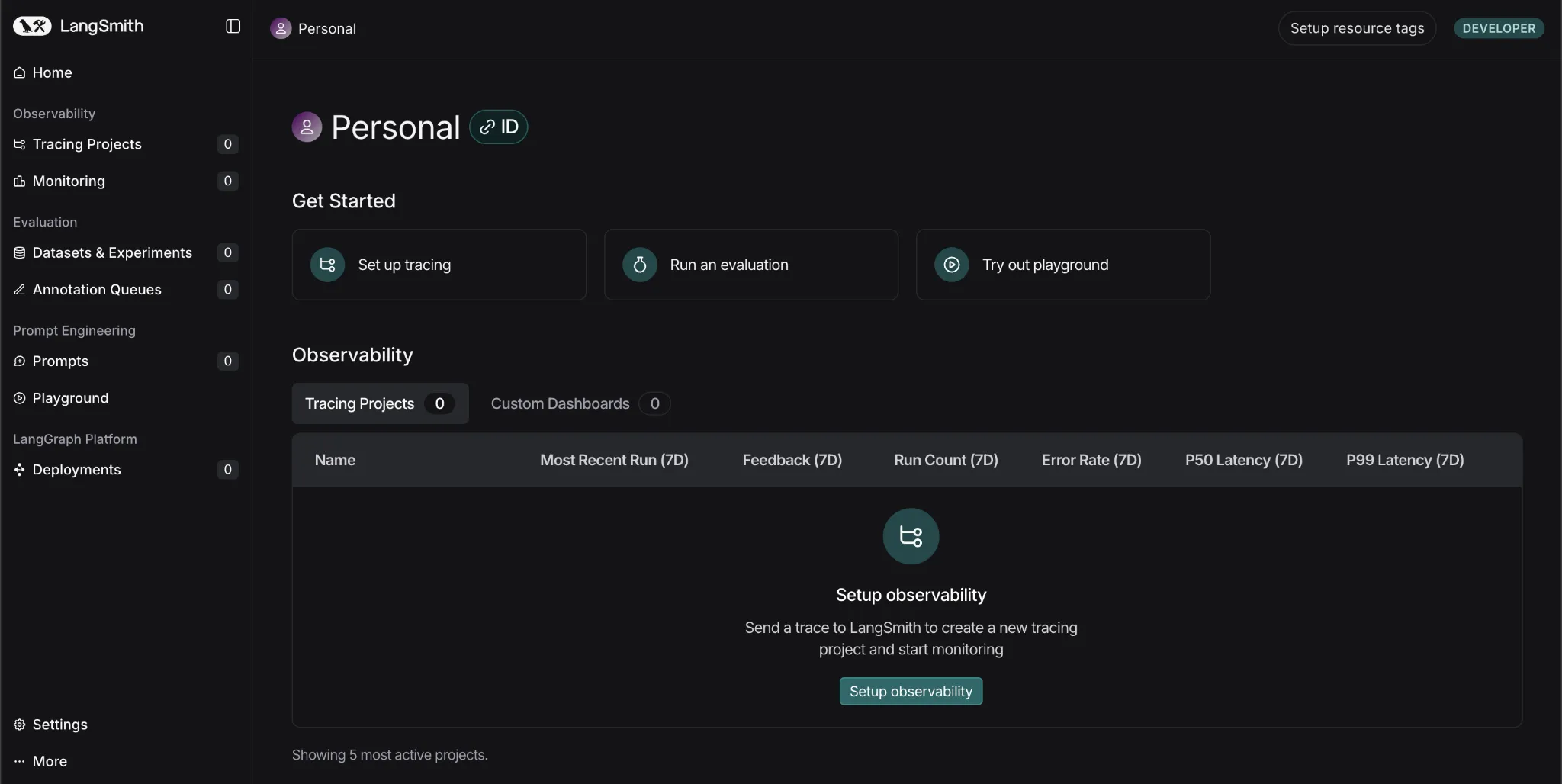
LangSmith Dashboard

That is how the platform seems with a number of tabs: 

  • Tracing Initiatives: Retains a monitor of a number of initiatives together with their traces or units of runs. Right here, the prices, errors, latency, and plenty of different issues are tracked.  
  • Monitoring: Right here you possibly can set alerts to warn you, as an example, if the system fails or the latency is above the set threshold.  
  • Dataset & Experiments: Right here, you possibly can run experiments utilizing human-crafted datasets or use the platform to create AI-generated datasets for testing your system. You too can change your mannequin to see how the efficiency varies.  
  • Prompts: Right here you possibly can retailer a number of prompts and later change the wording or sequence of directions to see how your outcomes are altering.  

LangSmith in Motion

Notice: We’ll solely construct easy brokers for this tutorial to concentrate on the LangSmith facet of issues.  

Let’s construct a basic math expression-solving agent that makes use of a easy instrument after which allow traceability. After which we’ll verify the LangSmith dashboard to see what will be tracked utilizing the platform.  

Getting the API keys: 

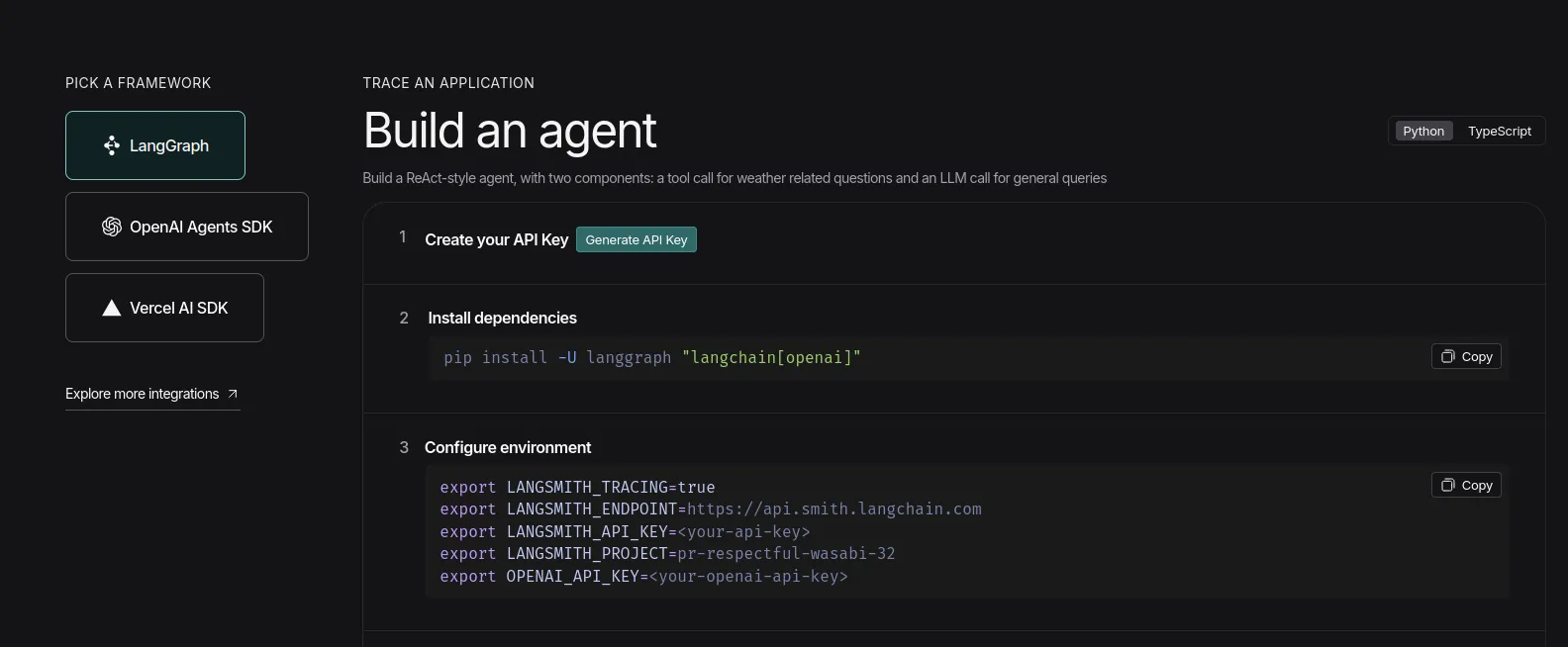
  1. Go to the Langsmith dashboard and click on on the ‘Setup Observability’ Button. You then’ll see this display screen. https://www.langchain.com/langsmith 
Building an agent

Now, click on on the ‘Generate API Key’ possibility and preserve the LangSmith key helpful.  

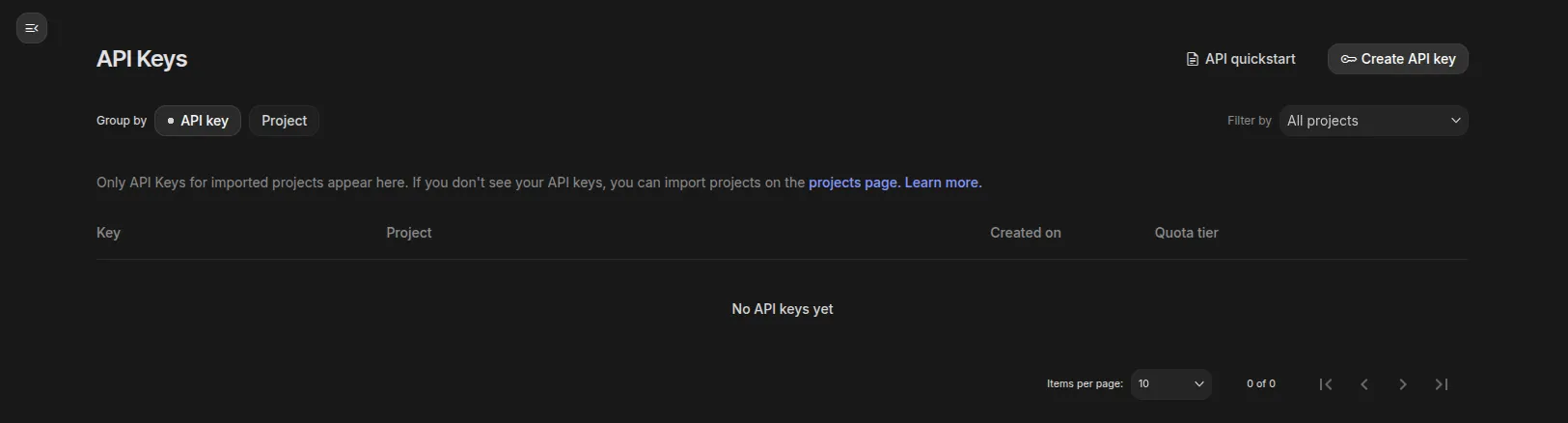
  1. Now go to Google AI Studio to get your palms on the Gemini API key: https://aistudio.google.com/api-keys  
API Keys

Click on on ‘Create API key’ on the right-top and create a mission if it doesn’t exist already, and preserve the important thing helpful. 

Python Code

Notice: I’ll be utilizing Google Colab for operating the code.

Installations 

!pip set up -q langgraph langsmith langchain  !pip set up -q langchain-google-genai

Notice: Ensure that to restart the session earlier than persevering with from right here.  

Setting the atmosphere 

Move the API keys when prompted.  

from getpass import getpass  LANGCHAIN_API_KEY=getpass('Enter LangSmith API Key: ')  GOOGLE_API_KEY=getpass('Enter Gemini API Key: ')  import os  os.environ['LANGCHAIN_TRACING_V2'] = 'true'  os.environ['LANGCHAIN_API_KEY'] = LANGCHAIN_API_KEY  os.environ['LANGCHAIN_PROJECT'] = 'Testing'

Notice: It’s really helpful to trace totally different initiatives with totally different mission names; right here, I’m naming it ‘Testing’. 

Establishing and operating the agent 

  • Right here, we’re utilizing a easy instrument that the agent can use to unravel math expressions 
  • We’re utilizing the in-built create_react_agent from LangGraph, the place we have now to outline the mannequin, give entry to instruments, and we’re good to go. 
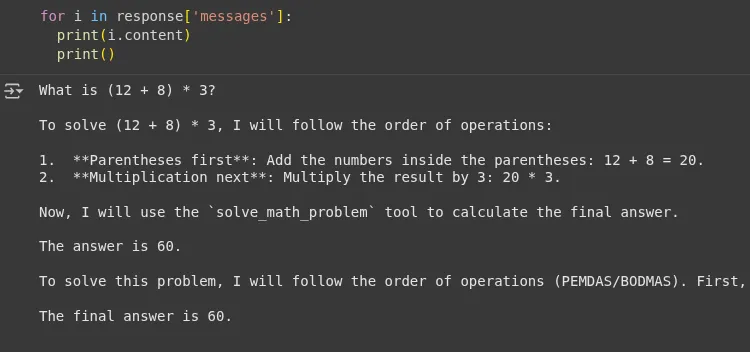
from langgraph.prebuilt import create_react_agent  from langchain_google_genai import ChatGoogleGenerativeAI  def solve_math_problem(expression: str) -> str:     """Remedy a math drawback."""     strive:      # Consider the mathematical expression      outcome = eval(expression, {"__builtins__": {}})      return f"The reply is {outcome}."     besides Exception:      return "I could not resolve that expression."  # Initialize the Gemini mannequin with API key  mannequin = ChatGoogleGenerativeAI(     mannequin="gemini-2.5-flash",     google_api_key=GOOGLE_API_KEY  )  # Create the agent  agent = create_react_agent(     mannequin=mannequin,     instruments=[solve_math_problem],     immediate=(      "You're a Math Tutor AI. "      "When a person asks a math query, cause by means of the steps clearly "      "and use the instrument `solve_math_problem` for numeric calculations. "      "At all times clarify your reasoning earlier than giving the ultimate reply."     ),  )  # Run the agent  response = agent.invoke(     {"messages": [{"role": "user", "content": "What is (12 + 8) * 3?"}]}  )  print(response)

Output: 

Output

We are able to see that the agent used the instrument’s response ‘The reply is 60’ and didn’t hallucinate whereas answering the query. Now let’s verify the LangSmith dashboard.  

LangSmith Dashboard

Tracing Initiatives tab 

Tracking Projects

We are able to see that the mission has been created with the identify ‘testing’; you possibly can click on on it to see detailed logs.  

Testing
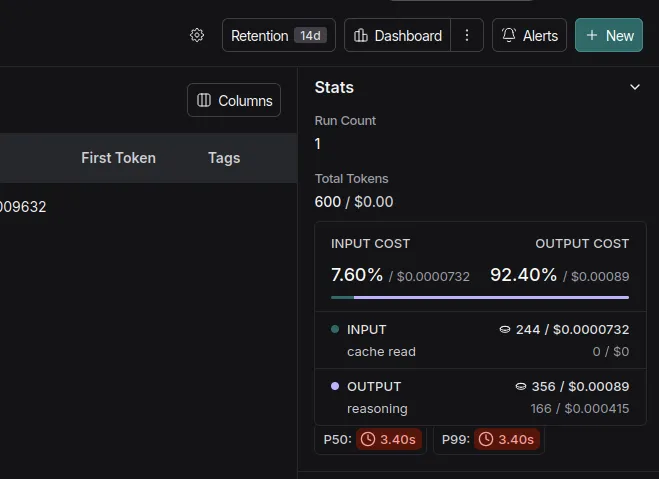
Token cost

Right here it exhibits the run-wise: 

  • Complete Tokens 
  • Complete Value 
  • Latency 
  • Enter 
  • Output 
  • Time when the code was executed 

Notice: I’m utilizing the free tier of Gemini right here, so I can use the important thing freed from price in line with the each day limits.  

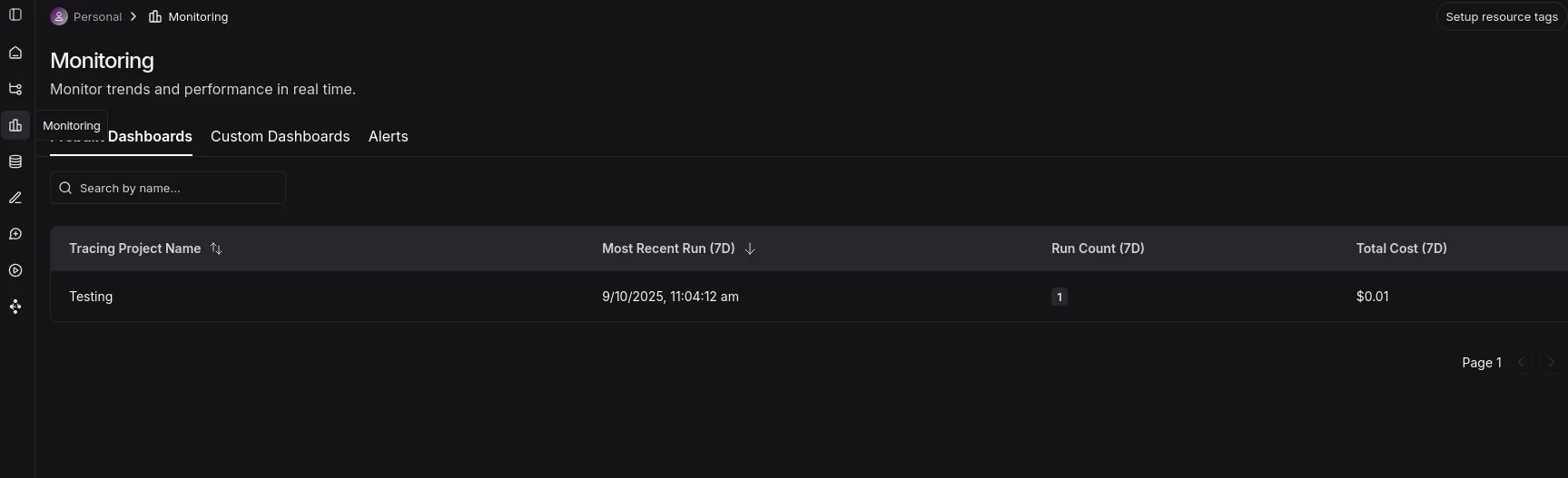
Monitoring tab 

  • Right here you possibly can see a dashboard with the initiatives, runs, and whole prices.  
Monitoring

LLM as a decide

LangSmith permits the creation of a dataset utilizing a easy dictionary with enter and output keys. This dataset with the anticipated output can be utilized to judge an AI system’s generated outputs on metrics like helpfulness, correctness, and hallucinations.  

We’ll use an identical math agent, create the dataset, and consider our agentic system.  

Notice: I’ll be utilizing OpenAI API (gpt-4o-mini) for the demo right here, that is to keep away from API Restrict points with the free-tier Gemini API.  

Installations 

!pip set up -q openevals langchain-openai 

Surroundings Setup 

import os  from google.colab import userdata  os.environ['OPENAI_API_KEY']=userdata.get('OPENAI_API_KEY')

Defining the Agent 

from langsmith import Consumer, wrappers  from openevals.llm import create_llm_as_judge  from openevals.prompts import CORRECTNESS_PROMPT  from langchain_openai import ChatOpenAI  from langgraph.prebuilt import create_react_agent  from langchain_core.instruments import instrument  from typing import Dict, Record  import requests  # STEP 1: Outline Instruments for the Agent =====  @instrument  def solve_math_problem(expression: str) -> str:     """Remedy a math drawback."""     strive:      # Consider the mathematical expression      outcome = eval(expression, {"__builtins__": {}})      return f"The reply is {outcome}."     besides Exception:      return "I could not resolve that expression."  # STEP 2: Create the LangGraph ReAct Agent =====  def create_math_agent():     """Create a ReAct agent with instruments."""     # Initialize the LLM     mannequin = ChatOpenAI(mannequin="gpt-4o-mini", temperature=0)     # Outline the instruments     instruments = [solve_math_problem]     # Create the ReAct agent utilizing LangGraph's prebuilt operate     agent = create_react_agent(      mannequin=mannequin,      instruments=[solve_math_problem],      immediate=(          "You're a Math Tutor AI. "          "When a person asks a math query, cause by means of the steps clearly "          "and use the instrument `solve_math_problem` for numeric calculations. "          "At all times clarify your reasoning earlier than giving the ultimate reply."      ),     )     return agent

Creating the dataset 

  • Let’s create a dataset with easy and exhausting math expressions that we will later use to run experiments.  
shopper = Consumer()  dataset = shopper.create_dataset(     dataset_name="Math Dataset",     description="Arduous numeric + blended arithmetic expressions to judge the solver agent."  )  examples = [     # Simple check     {      "inputs": {"question": "12 + 7"},      "outputs": {"answer": "The answer is 19."},     },     {      "inputs": {"question": "100 - 37"},      "outputs": {"answer": "The answer is 63."},     },     # Mixed operators and parentheses     {      "inputs": {"question": "(3 + 5) * 2 - 4 / 2"},      "outputs": {"answer": "The answer is 14.0."},     },     {      "inputs": {"question": "2 * (3 + (4 - 1)*5) / 3"},      "outputs": {"answer": "The answer is 14.0."},     },     # Large numbers & multiplication     {      "inputs": {"question": "98765 * 4321"},      "outputs": {"answer": "The answer is 426,373,565."},     },     {      "inputs": {"question": "123456789 * 987654321"},      "outputs": {"answer": "The answer is 121,932,631,112,635,269."},     },     # Division, decimals, rounding     {      "inputs": {"question": "22 / 7"},      "outputs": {"answer": "The answer is approximately 3.142857142857143."},     },     {      "inputs": {"question": "5 / 3"},      "outputs": {"answer": "The answer is 1.6666666666666667."},     },     # Exponents, roots     {      "inputs": {"question": "2 ** 10 + 3 ** 5"},      "outputs": {"answer": "The answer is 1128."},     },     {      "inputs": {"question": "sqrt(2) * sqrt(8)"},      "outputs": {"answer": "The answer is 4.0."},     },     # Edge / error / “unanswerable” cases     {      "inputs": {"question": "5 / 0"},      "outputs": {"answer": "I couldn’t solve that expression."},     },     {      "inputs": {"question": "abc + 5"},      "outputs": {"answer": "I couldn’t solve that expression."},     },     {      "inputs": {"question": ""},      "outputs": {"answer": "I couldn’t solve that expression."},     },  ]  shopper.create_examples(     dataset_id=dataset.id,     examples=examples)

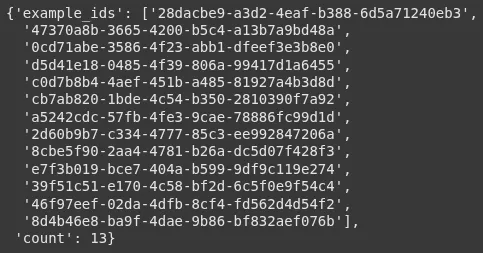
Nice! We created a dataset with 13 data:

Example ID dictionary

Defining the goal operate 

  • This operate invokes the agent and returns the response 
def goal(inputs: Dict) -> Dict:     agent = create_math_agent()     agent_input = {      "messages": [{"role": "user", "content": inputs["question"]}]     }     outcome = agent.invoke(agent_input)     final_message = outcome["messages"][-1]     reply = final_message.content material if hasattr(final_message, 'content material') else str(final_message)     return {"reply": reply}

Defining the Evaluator 

  • We use the pre-built llm_as_judge operate and likewise import the immediate from the openevals library. 
  • We’re utilizing 4o-mini for now to maintain the prices low, however a reasoning mannequin will be higher fitted to this process.  
def correctness_evaluator(inputs: Dict, outputs: Dict, reference_outputs: Dict) -> Dict:     evaluator = create_llm_as_judge(      immediate=CORRECTNESS_PROMPT,      mannequin="openai:gpt-4o-mini",      feedback_key="correctness",     )     eval_result = evaluator(      inputs=inputs,      outputs=outputs,      reference_outputs=reference_outputs     )     return eval_result

Working the analysis 

experiment_results = shopper.consider(     goal,     knowledge="Math Dataset",     evaluators=[correctness_evaluator],     experiment_prefix="langgraph-math-agent",     max_concurrency=2,  )

Output:

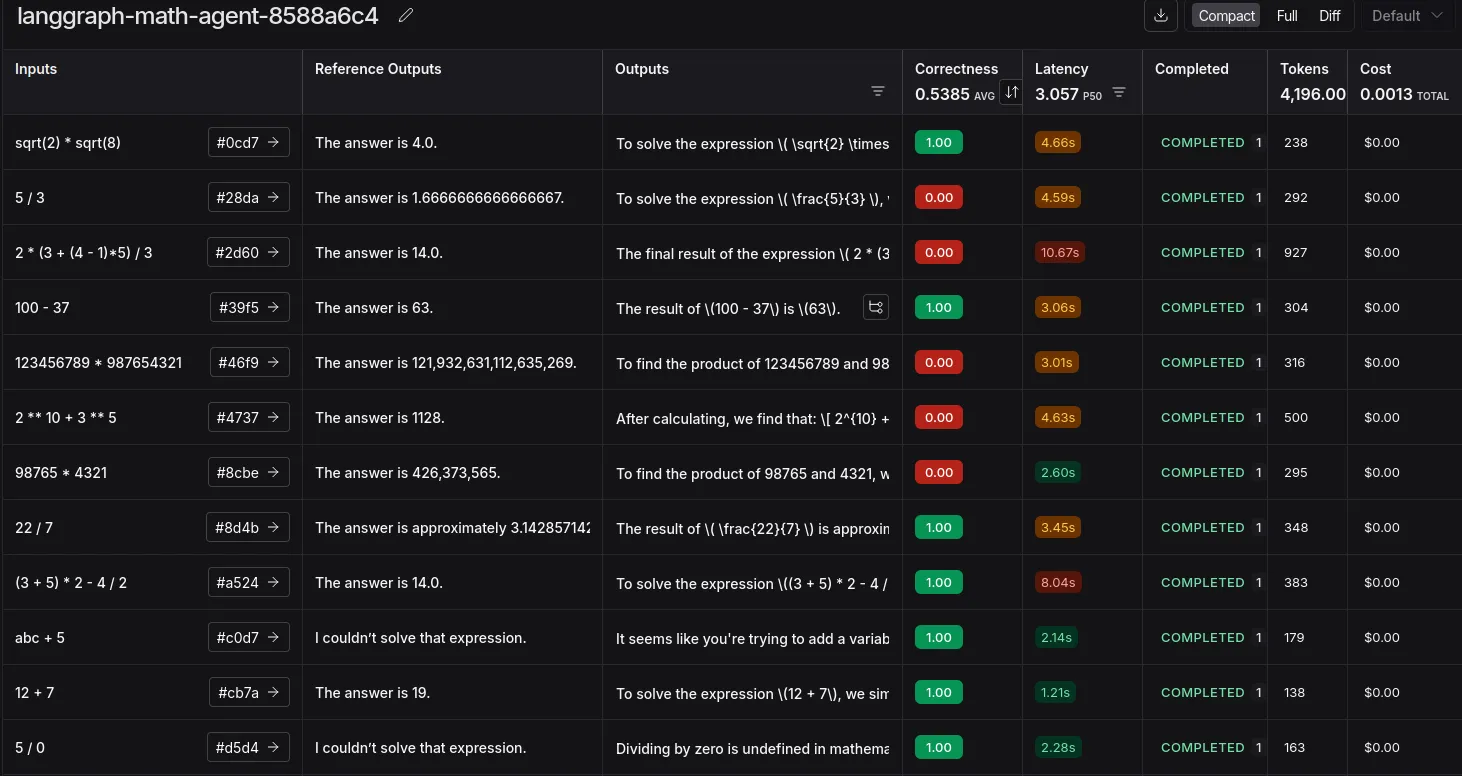
A hyperlink will probably be generated after the run. On click on, you’ll be redirected to LangSmith’s ‘Datasets & Experiments’ tab, the place you possibly can see the outcomes of the experiment.  

Agent monitoring dashboard

Now we have efficiently experimented with utilizing LLM as a Decide. That is insightful when it comes to discovering edge instances, prices, and token utilization.  

The errors listed here are principally mismatched because of the usage of commas or the presence of lengthy decimals. This may be solved by altering the analysis immediate or attempting a reasoning mannequin. Or simplify including commas and guaranteeing decimal formatting on the instrument degree itself.  

Conclusion

And there you’ve got it! We’ve efficiently proven the intertwined working of LangGraph for constructing our agent and LangSmith for tracing and evaluating it. This combo is extremely highly effective for monitoring bills and guaranteeing your agent performs as anticipated with customized datasets. Whereas we targeted on tracing and experiments, LangSmith’s capabilities don’t cease there. You too can discover highly effective options like A/B testing totally different prompts in manufacturing, including human-in-the-loop suggestions on to traces, and creating automations to streamline your debugging workflow. 

Incessantly Requested Questions

Q1. What does the -q flag imply in “pip set up -q”? 

A. The -q (or –quiet) flag tells pip to be “quiet” throughout set up. It reduces the log output, making your pocket book cleaner by solely exhibiting vital warnings or errors. 

Q2. What’s the primary distinction between LangChain and LangGraph? 

A. LangChain is greatest for creating sequential chains of actions. LangGraph extends this by letting you outline complicated, cyclical flows with conditional logic, which is important for constructing refined brokers. 

Q3. Is LangSmith just for brokers constructed with LangGraph? 

A. No, LangSmith is framework-agnostic. You may combine it into any LLM software to get tracing and analysis, even when it’s constructed from scratch utilizing libraries like OpenAI’s straight. 

Captivated with know-how and innovation, a graduate of Vellore Institute of Know-how. At present working as a Information Science Trainee, specializing in Information Science. Deeply desirous about Deep Studying and Generative AI, desirous to discover cutting-edge methods to unravel complicated issues and create impactful options.

Login to proceed studying and revel in expert-curated content material.