Home Blog Page 36

5 Tricks to Architecting an Apache Iceberg Lakehouse

0

(Gorodenkoff/Shutterstock)

The rise of synthetic intelligence (AI) has reshaped the way in which enterprises take into consideration information. AI brokers, machine studying fashions, and fashionable analytics all rely upon well timed entry to high-quality, well-governed information. That is why the information lakehouse structure has grow to be so essential, because it unifies the flexibleness and scalability of knowledge lakes with the reliability and governance of knowledge warehouses. By doing so, it not solely reduces prices but additionally ensures that AI tooling can function on enterprise-wide information in a seamless and ruled method.

 With extra organizations shifting towards this structure, Apache Iceberg has emerged because the open desk format on the heart of the trendy lakehouse. Iceberg offers the muse for constant, scalable, and interoperable information storage throughout a number of engines.

 As outlined in Architecting an Apache Iceberg Lakehouse (Manning, 2025), practitioners ought to apply 5 high-level tricks to designing and implementing an Iceberg-based lakehouse; thereby, approaching their lakehouse journey with readability and confidence. These embrace:

  1. Conduct an Architectural Audit

(Shutterstock)

Earlier than selecting instruments or constructing pipelines, probably the most essential step is to grasp the place to start. This implies conducting an architectural audit. To start out, meet with stakeholders akin to information engineers, analysts, enterprise customers, and compliance groups to gather a transparent image of how information is presently used. Ask questions like: 

  • The place are the most important bottlenecks in accessing and analyzing information?
  • What governance or compliance necessities have to be met?
  • How is information shared throughout enterprise items as we speak, and what limitations exist?

By consolidating this information, organizations can construct a necessities doc that captures the purposeful and non-functional wants of the group. The ensuing doc will then function the north star all through the design course of, maintaining the crew targeted on fixing the proper issues quite than chasing each shiny new function distributors will current.

  1. Construct a Native Prototype

As soon as necessities are outlined, the following step is to experiment in a protected, native atmosphere. As an illustration, prototyping on a laptop computer is straightforward because of open-source applied sciences/capabilities like these:

 Dremio Neighborhood Version or Trino OSS for querying and federating information.

  • MinIO for offering an S3-compatible object retailer.
  • Venture Nessie for data-as-code catalog performance.
  • Apache Iceberg itself serves because the foundational desk format.

By establishing a mock lakehouse on a laptop computer or in a small dev atmosphere, information engineers can acquire a hands-on understanding of how the items match collectively. This additionally helps them visualize the end-to-end move of knowledge, from ingestion to governance to analytics, earlier than having to make large-scale architectural choices. The teachings discovered may also assist throughout prototyping by giving them confidence and readability when it comes time to scale.

 3: Examine Distributors In opposition to Your Necessities

When prepared to guage distributors, it’s straightforward to get swept up in flashy demos and advertising and marketing claims. Distributors will emphasize the strengths of their platform, however these strengths might not truly align with what the group truly wants.

Once more, that is the place the necessities doc turns into invaluable. As a substitute of letting distributors outline the dialog, the sooner outlined necessities will function a  cognitive filter. Ask every vendor to reveal how they meet the particular wants recognized, akin to governance, price effectivity, or AI-readiness, quite than merely showcasing their broadest function set.

 This method not solely saves time but additionally ensures that the enterprise is constructing a lakehouse that solves the group’s issues, not one optimized for another person’s priorities. Keep in mind, the suitable vendor isn’t the one with the longest function listing, however the one whose capabilities map most carefully to the necessities uncovered in the course of the architectural audit.

 4: Grasp the Metadata Tables

Apache Iceberg isn’t nearly scalable tables; it additionally offers metadata tables that give deep visibility into the state of the enterprise’ information. These embrace tables that present snapshot historical past, file manifests, partition statistics, and extra. By studying methods to question and interpret these metadata tables, information professionals can:

  • Monitor desk well being and detect points early.
  • Determine when compaction, clustering, or cleanup jobs are literally wanted.
  • Change inflexible upkeep schedules with clever, event-driven upkeep primarily based on real-time situations. 

For instance, quite than compacting information each night time at midnight, organizations would possibly use metadata tables to set off compaction solely when small information accumulate past a threshold. This sort of adaptive optimization helps maintain prices underneath management whereas sustaining constantly excessive efficiency. Mastering Iceberg’s metadata is likely one of the most potent methods to function the lakehouse effectively, reworking routine upkeep into a wiser, data-driven course of.

 5: Place the Enterprise for the Polaris Future

An information lakehouse catalog or metadata catalog is the spine of any Iceberg lakehouse. It determines how tables are organized, ruled, and accessed throughout engines. At this time, many distributors are already adopting or integrating with Apache Polaris, the open-source catalog constructed on the Iceberg REST protocol.

 Quite a few distributors have introduced Polaris-based Catalog choices ,and extra are following carefully behind. This momentum alerts that Polaris is on monitor to grow to be the industry-standard catalog for Iceberg-based architectures. This implies if you happen to’re self-managing, deploying Polaris can guarantee future interoperability. Ought to the enterprise desire a managed answer, it’s vital to pick a vendor that already offers a Polaris-based catalog.

By aligning the lakehouse catalog technique with Polaris, you’re not solely fixing as we speak’s challenges but additionally making ready for an ecosystem the place interoperability and cross-engine consistency are the norm. This foresight will guarantee your structure scales gracefully because the Iceberg ecosystem matures.

 TLDR? Listed below are the Highlights…

(bsd-studio/Shutterstock)

Architecting a contemporary information lakehouse isn’t nearly expertise; it’s about considerate design, planning, and execution. Apache Iceberg offers the muse for constructing a scalable, ruled, and interoperable lakehouse, however success is determined by how organizations method the journey. Concerns embrace:

 Begin with an architectural audit to floor the design in actual organizational wants.

  1. Prototype domestically to construct instinct and confidence earlier than scaling.
  2. Consider distributors towards necessities, not towards their advertising and marketing.
  3. Leverage Iceberg’s metadata tables for clever upkeep and optimization.
  4. Future-proof the catalog technique by aligning with Polaris.

These 5 suggestions solely scratch the floor of what’s potential. The organizations that succeed within the AI period will probably be those who deal with information as a strategic asset, accessible, ruled, and optimized for each human and machine intelligence. With Apache Iceberg on the core of the lakehouse, and a considerate structure behind it, organizations will  be prepared to satisfy that problem head-on.

In regards to the Creator: Alex Merced is the co-author of “Apache Iceberg: The Definitive Information” and Head of Developer Relations at Dremio, suppliers of the main, unified lakehouse platform for self-service analytics and AI. With expertise as a developer and teacher, his skilled journey contains roles at GenEd Programs, Crossfield Digital, CampusGuard, and Normal Meeting. He co-authored “Apache Iceberg: The Definitive Information” printed by O’Reilly and has spoken at notable occasions akin to Information Day Texas and Information Council. 

Selective retraining helps AI study new expertise with out forgetting, research finds

0

To check whether or not this drawback holds for right now’s giant multimodal fashions, the workforce performed a managed analysis. They skilled the chosen fashions on 5 goal duties, together with fine-grained fowl classification, counting, medical visible query answering, OCR studying, and time studying. They then measured how a lot efficiency dropped throughout eight customary benchmarks that weren’t a part of the fine-tuning set.

These experiments led to 2 key discoveries, in line with the paper. Tuning solely the self-attention projection layers (SA Proj), the a part of the mannequin that helps it resolve which enter components to deal with, allowed the fashions to study new duties with little or no measurable forgetting. Additionally, what initially appeared as forgotten information usually resurfaced when the mannequin was later skilled on one other specialised process.

“We thus hypothesize that maybe what appears to be like like forgetting or interference after fine-tuning on a slim goal process is definitely bias within the output distribution because of the process distribution shift,” the researchers added. “By in-depth evaluation when tuning the counting process, we affirm this speculation: tuning the MLP will increase goal accuracy but additionally will increase the probability of outputting numeric tokens and a extremely correlated drop in held-out process accuracy, whereas tuning the self-attention achieves the goal studying with out a lot bias towards numeric tokens and with out shedding held-out accuracy.”

Synthetic Intelligence (AI) in Cellular Telephones – Is It a Good Factor or Not

0

It’s wild to suppose how far telephones have come up to now 20 years. In 2000, essentially the most outstanding characteristic was the introduction of polyphonic ringtones; in 2005, it was the inclusion of built-in cameras and colour screens; in 2009, it was the appearance of touchscreens and app shops.

And in 2015, it was the mixing of fingerprint recognition and cell wallets (based on Deloitte, 47% of respondents now use their telephones to pay for items and providers in-store).

Nonetheless, trendy smartphones are already able to predicting our subsequent phrase, recognizing faces, naturally bridging languages, and even modifying pictures. The driving power behind all this intelligence and autonomy comes largely from synthetic intelligence (AI).

For smartphone producers, in flip, the flexibility to supply a variety of AI options is turning into extraordinarily vital. With the share of AI-capable smartphones anticipated to surge within the coming years, AI now represents a key promoting level as a part of any new product launch.

On this article, we’ll discover how AI works inside cell gadgets, what applied sciences energy it, and the right way to discover an AI improvement firm that may assist carry clever options to your individual cell app.
Synthetic Intelligence (AI) in Cellular Telephones – Is It a Good Factor or Not

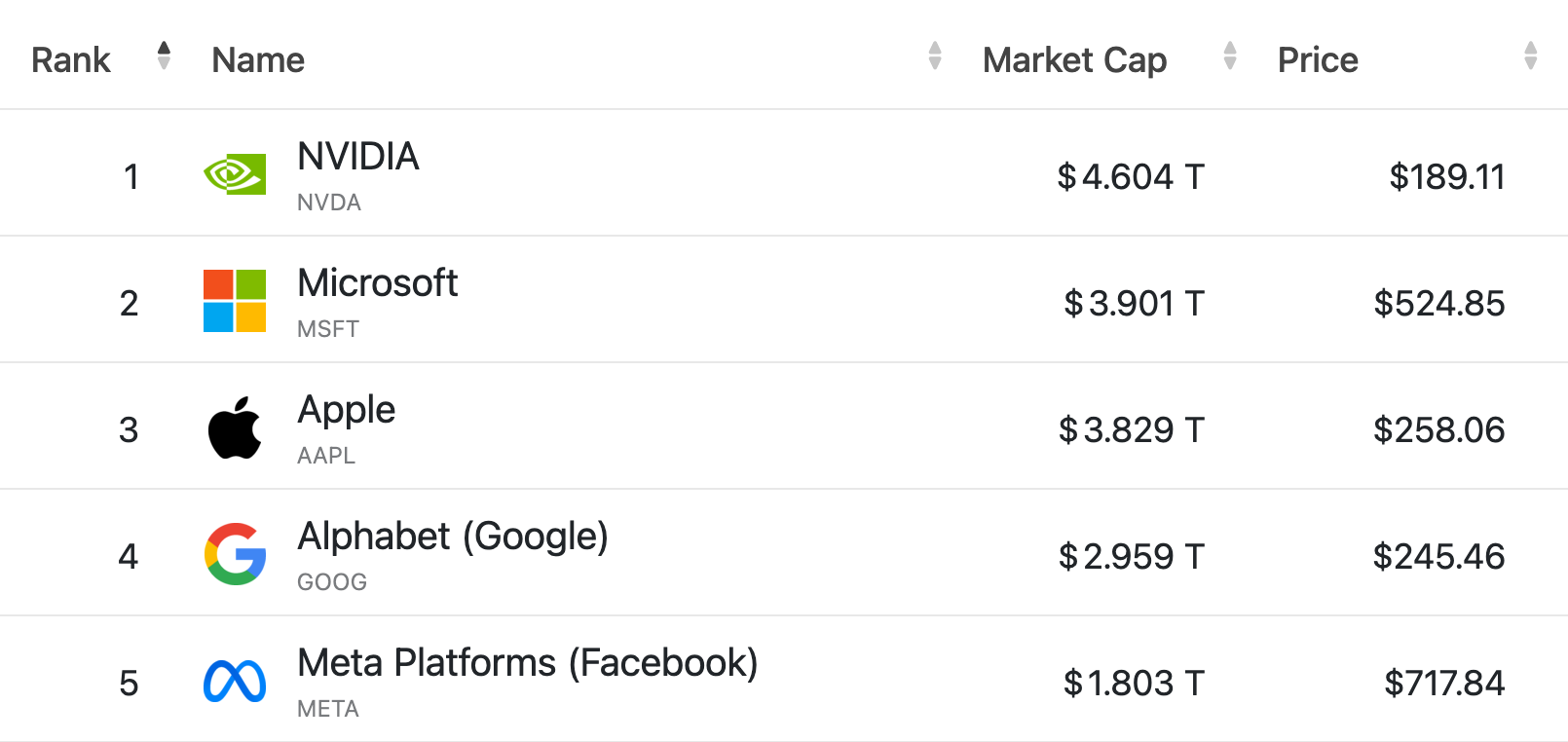
Main AI Corporations Globally 2025 by Market Cap, CompaniesMarketcap.com

What Is AI in Cellular Telephones?

Primarily, AI on cell gadgets means integrating clever algorithms into smartphones to allow them to study from consumer habits and carry out issues that had been beforehand solely doable with human-like reasoning.

The definition of an AI in smartphones has usually targeted extra on the mixing of AI-powered options and experiences relatively than simply the {hardware}.

Not like AI-powered PCs, the place the important thing advertising and marketing issue was the addition of a specialised AI chip or accelerator, the categorization of an AI-powered smartphone has usually been extra about what it does for the consumer.

How Synthetic Intelligence Works in Smartphones

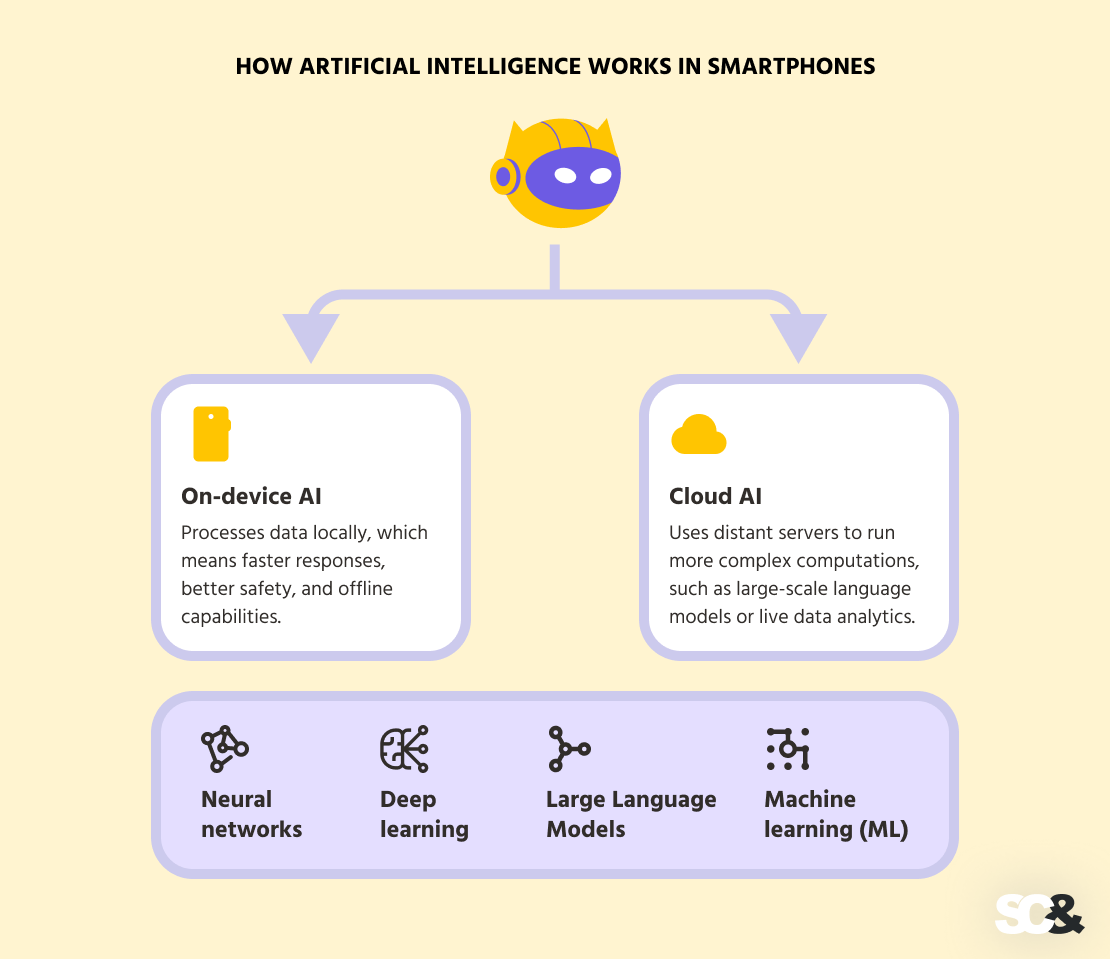
AI features will be executed both on the gadget or within the cloud.

  • On-device AI processes information domestically, which implies sooner responses, higher security, and offline capabilities.
  • Cloud AI makes use of distant servers to run extra complicated computations, comparable to large-scale language fashions or reside information analytics.

Most of at present’s smartphones, although, use a hybrid strategy, combining each to get one of the best efficiency and energy administration.

Apart from, AI in telephones depends on a sequence of underlying applied sciences — machine studying (ML), deep studying (DL), and neural networks — every with a distinct perform.

  • Neural networks mimic the construction of the human mind and function the inspiration for many trendy AI fashions.
  • Deep studying is a extra superior type of neural networks that makes use of a number of layers to course of complicated inputs comparable to speech, photographs, and gestures — basically scaling up conventional neural networks for larger efficiency.
  • Giant Language Fashions, a subset of deep studying, specialise in understanding and producing pure language. They’re now being tailored for cell real-time textual content era, translation, and conversational AI.
  • Machine studying (ML) stays the broader area below which neural networks and deep studying function.
How AI Works

How AI Works in Smartphones

Main AI Applied sciences Behind Trendy Smartphones

Machine studying, deep studying, and neural networks don’t function alone — they depend on specialised processing strategies and {hardware} to ship real-world performance.

Neural Processing Items (NPUs)

On the coronary heart of AI-driven smartphones lies the Neural Processing Unit (NPU) — a devoted chip for processing AI and ML workloads.

Not like common CPU or GPU chips, which deal with basic computing, NPUs are constructed to course of many AI calculations on the identical time. They energy all the things from picture processing and reside translation to predictive typing and app options.

Pure Language Processing (NLP)

NLP lets telephones perceive and reply to human language. It’s the core know-how behind all in style voice assistants, serving to them acknowledge what customers say, perceive what they imply, and reply naturally.

Trendy NLP may even decide up on tone, context, and slang, making conversations really feel extra true-to-life. Apart from voice instructions, it additionally powers good replies in messages, voice-to-text typing, and translations.

Pc Imaginative and prescient and Picture Recognition

Pc imaginative and prescient offers smartphones the flexibility to “see” and perceive what’s round them. With the assistance of deep studying and enormous quantities of picture information, telephones can acknowledge faces, objects, and scenes with spectacular accuracy.

This know-how powers many digicam options we use on daily basis — portrait mode, night time images, auto scene detection, Face ID, and visible search.

Edge AI

Edge AI implies that a cellphone can course of AI duties straight on the gadget as an alternative of sending information to cloud servers. This shift improves efficiency, reduces latency, and strengthens privateness since private information by no means has to depart the cellphone.

Telephones with particular AI chips — like Apple’s Neural Engine or Google’s Tensor — use Edge AI to energy real-time picture enhancement, on the spot translation, and predictive typing. In brief, it helps a cellphone keep good, fast, and safe — all by itself.

On a regular basis Purposes of AI in Cellular Telephones

Many main smartphone producers have demonstrated the potential of AI in smartphone consumer interfaces, showcasing a wealth of modifying, help, and consumer expertise instruments accessible with a faucet, swipe, or just by voice.

AI in Mobile Phones

Let’s take a look at how synthetic intelligence works in observe throughout totally different areas of cell use.

Cellular Images and Videography

Smartphone cameras are among the many most superior makes use of of AI know-how. AI-powered picture processing makes use of convolutional neural networks (CNNs) to investigate lighting, colour, and object composition in actual time.

When people take a photograph, the NPU of their telephones runs quite a few algorithms in milliseconds to find out the scene — panorama, portrait, or night time shot — and routinely alter publicity, white stability, and depth.

For portrait images, AI makes use of semantic segmentation to separate the topic and dim the background in a method that simulates a DSLR’s blur. For low-light images, multi-frame picture stacking takes a sequence of pictures and stacks them into one high-quality picture with much less noise.

AI additionally helps HDR optimization and reside video stabilization utilizing predictive movement monitoring.

Some telephones, like Google’s Pixel sequence, even use computational images strategies run by machine studying to recreate pure pores and skin tones or take away undesirable objects from photographs.

Voice Assistants

Voice assistants comparable to Siri, Google Assistant, and Bixby make use of pure language processing (NLP) and computerized speech recognition (Speech-to-Textual content, STT) to show spoken phrases into machine-readable instructions.

When customers communicate to the assistant, their voice is first analyzed by way of acoustic modeling with a view to acknowledge phonemes — essentially the most elemental sound items.

Then, language fashions interpret context and intent, turning phrases like “Remind me to name Alex at 6” into executable duties.

AI additionally makes use of contextual studying, i.e., the assistant turns into clever with time by way of insights from previous requests, calendar, and even geographical location.

For instance, if a consumer repeatedly asks for the climate when leaving dwelling, it will probably routinely begin to give them that data.

Lastly, Textual content-to-Speech (TTS) permits the assistant to generate pure, human-like responses straight on the gadget, making interactions extra fluid and conversational with out counting on cloud processing.

Predictive Textual content and Good Typing

Behind each autocomplete suggestion lies a recurrent neural community (RNN) or transformer-based mannequin skilled on thousands and thousands of language samples. These fashions predict customers’ subsequent phrase primarily based on chance — studying from their typing patterns, incessantly used phrases, and emoji preferences.

AI additionally powers clever autocorrect, which doesn’t simply repair spelling however understands intent.

For example, it is aware of a consumer meant “assembly” as an alternative of “meting” primarily based on sentence context. Over time, the keyboard adapts to their private language fashion, enhancing accuracy with every use.

Personalization and Suggestions

AI constantly research consumer interactions to ship a personalised cell expertise. Utilizing behavioral evaluation, reinforcement studying, and contextual modeling, smartphones can predict particular wants in actual time.

For instance, a tool can suggest apps that customers incessantly open at sure occasions of day or routinely change to battery-saving mode when the battery is low.

Music and video apps use collaborative filtering, suggesting new content material primarily based on the consumer’s listening or viewing habits.

System-level personalization, comparable to adaptive brightness, makes use of the cellphone’s environmental sensors and AI fashions to study particular preferences primarily based on lighting circumstances.

Safety and Authentication

AI-powered safety is often primarily based on biometric recognition and anomaly detection.

AI-powered security

For Face ID or facial unlock, a cellphone captures a depth map and runs it by way of a 3D convolutional neural community (3D-CNN) skilled to acknowledge distinctive facial traits, even when the looks barely modifications.

Fingerprint recognition has additionally advanced: AI filters out noise from sensor information and applies pattern-matching algorithms for sooner and safer authentication.

Behavioral AI goes even additional. Now it will probably analyze how individuals work together with their telephones (typing velocity, tilt, strain) to catch suspicious exercise or potential fraud.

Cellular Gaming and Augmented Actuality (AR)

In gaming, AI controls non-player characters (NPCs) utilizing choice timber, reinforcement studying, or behavioral modeling to create dynamic, responsive gameplay. These characters can adapt to a play fashion, making every session extra lifelike.

In augmented actuality, AI improves spatial understanding by way of simultaneous localization and mapping (SLAM) — a course of that helps a cellphone map bodily areas on the go.

Mixed with object recognition and depth sensing, this enables apps like Pokémon GO or AR navigation instruments to mix digital objects into the true world.

Automation

AI is increasingly more used to automate redundant duties. With context-based triggers and rule-based ML, a cellphone can silence notifications throughout conferences, alter energy utilization primarily based on exercise, or schedule routine upkeep within the background.

Space How AI Works Examples / Options
Images & Video CNNs and NPUs alter lighting, focus, and depth routinely Scene detection, portrait blur, low-light stacking, HDR, video stabilization
Voice Assistants NLP interprets speech and learns context Siri, Google Assistant, Bixby; reminders, contextual options
Predictive Typing RNNs/transformers predict phrases and adapt Autocomplete, emoji options, context-aware corrections
Textual content Processing (LLM-powered) Giant language fashions summarize, rewrite, and generate textual content Summarization, tone adjustment, good replies, content material era
Personalization Behavioral evaluation tailors the expertise App options, adaptive brightness, content material suggestions
Safety Biometric and behavioral AI enhances security Face ID, fingerprint recognition, fraud detection
Gaming & AR AI adapts NPCs and maps areas in AR Dynamic gameplay, AR apps like Pokémon GO, navigation instruments
Automation ML automates routine duties Good notifications, battery optimization, activity scheduling

Key AI Purposes in Cellular Telephones

Advantages vs. Challenges of AI Algorithms in Smartphones

The overwhelming majority of telecom operators view AI integration as a enterprise crucial. As of 2024, almost 90% of firms worldwide have totally or partially built-in this know-how into at the least one space of ​​their enterprise, whereas solely 3% haven’t any plans to take action.

Unsurprisingly, operators are typically trying to enhance productiveness. Nonetheless, there are lots of different advantages for enterprise.

For example, AI proves to boost gadget and app efficiency. Trendy smartphones use devoted {hardware}, comparable to Apple’s Neural Engine or Google’s Tensor, to run AI duties effectively on-device, cut back latency, save vitality, and decrease infrastructure and assist prices.

Past efficiency, AI strengthens safety and compliance. Deep studying improves fraud detection, identification verification, and behavioral authentication, whereas Edge AI and federated studying permit delicate information to remain on-device, making certain compliance with laws.

Lastly, AI boosts operational effectivity. It displays techniques, predicts potential points, optimizes sources, and powers chatbots or digital assistants to run routine duties.

On the identical time, adopting AI capabilities comes with a number of challenges. The primary one is price. Growing and sustaining AI techniques requires specialised expertise, high-performance {hardware}, and enormous datasets.

Smaller operators might wrestle to make these investments whereas competing with large-scale gamers.

Apart from, the wide selection of doable AI functions has left organizations divided on the place to direct sources, particularly when the return on funding is troublesome to quantify.

From a technical perspective, fragmentation in cell gadgets is one other downside. Completely different working techniques and {hardware} configurations can restrict AI performance or require builders to keep up a number of mannequin variations.

Apart from, complicated AI fashions eat vital processing energy and reminiscence, probably draining batteries or inflicting gadgets to overheat.

In fact, builders might use mannequin pruning, quantization, and information distillation to make fashions lighter and sooner, however these steps add complexity to the event course of.

Privateness and Moral Issues: Is It a Good Factor to Depend on AI

As synthetic intelligence app improvement emerges as an integral a part of cell enterprise methods, firms additionally face more and more rising privateness and moral dangers.

Good Thing to Rely on AI

To begin with, cellphone AI techniques are primarily based on monumental quantities of private data — from location and biometrics (face, voice, fingerprints) to utilization patterns of apps.

If such data is abused, leaked, or obtained illegally, companies face heavy penalties below GDPR or CCPA, together with a nasty popularity. Furthermore, the extra in depth the usage of AI for real-time personalization, the upper the chance of publicity.

Safety can also be excessive on the checklist. Each on-device and cloud AI are vulnerable to compromise by way of information tampering, adversarial enter, or mannequin inversion — assaults that attempt to extract or manipulate the interior information of the mannequin.

Bias and transparency points are not any much less vital. AI fashions are skilled from information which will have inherent biases, resulting in unfair ends in facial evaluation, content material suggestion, or hiring software program.

Lastly, since many deep studying fashions are “black containers,” it’s usually troublesome to elucidate how selections are made, which may trigger issues with regulators and customers.

And since legal guidelines usually lag behind know-how, companies that function in extraordinarily regulated industries usually tend to be fined, audited, and expertise compliance issues if AI applied sciences aren’t managed responsibly.

Case Research: AI in Main Smartphones (2025 Version)

Regardless of consumer considerations that stay a barrier to adoption, all smartphone market leaders are striving to combine superior AI options, whether or not on-device AI, cloud processing, or specialised {hardware}, comparable to neural processing items.

Apple

Apple is actively integrating AI into cell gadgets by way of Apple Intelligence, which reinforces the iPhone with a better AI agent, writing instruments, privacy-focused options, reside translation, picture playground, writing instruments, and mail/message abstract.

The corporate can also be collaborating with OpenAI to combine ChatGPT into its Apple Intelligence suite.

Main Apple AI-powered options embrace:

  • Face ID: Deep studying for facial recognition with anti-spoofing.
  • Stay Textual content/Object & OCR: Extracts textual content from photographs and movies in actual time.
  • Digital camera Enhancements: Good HDR, Evening Mode, and computational images depend on neural networks for scene detection, depth mapping, and noise discount.
  • Predictive Typing: Fashions analyze typing patterns to recommend the following phrases and emojis.

Google

Google continues to guide in AI innovations with its Tensor chipset and deep integration of AI throughout the Pixel ecosystem.

risks with AI in phones

The foremost synthetic intelligence features cowl:

  • Magic Eraser & Photograph Enhancements: Take away objects and alter lighting utilizing deep studying.
  • Name Screening: On-device speech recognition filters spam, whereas cloud NLP interprets complicated requests.
  • Actual-Time Translation: Partly on-device for velocity, with cloud assist for extra languages.
  • Adaptive Battery & Efficiency: AI predicts app use to handle sources and save battery.

Samsung

Samsung is positioning its Galaxy AI platform as a central aspect of its gadget technique. As key AI options, Samsung affords audio eraser, writing help, transcript help, shopping help, name help, and drawing help.

The system integrates:

  • Stay Translation & AR: Pc imaginative and prescient fashions for object recognition, textual content & voice translation, and AR overlays.
  • Good Crop & Digital camera AI: Scene detection and low-light enhancement powered by neural networks, in addition to picture modifying (deletion, motion, addition of objects).
  • Adaptive Battery & Useful resource Administration: Predictive fashions alter CPU/GPU load and background apps.
  • Well being & Biometric Monitoring: AI analyzes sensor information for coronary heart price, sleep, and stress monitoring.

Huawei, OnePlus, and Xiaomi

Huawei, OnePlus, and Xiaomi are additionally closely investing in AI to enhance efficiency, personalization, and imaging.

Huawei’s XMAGE system makes use of superior neural networks for colour tuning and object detection, whereas its Kirin NPUs course of duties like voice instructions and scene recognition offline.

OnePlus integrates AI into the OxygenOS atmosphere to allow good notifications, adaptive efficiency tuning, and improved picture readability.

Xiaomi continues to advance its HyperOS AI options, introducing AI portrait enhancements, context-aware assistants, and battery optimization pushed by on-device machine studying.

Future Developments & Innovation

The way forward for AI in cell applied sciences is intently tied to the rise of clever gadgets on the whole. Similar to AI PCs powered by NPUs, smartphones at the moment are geared up with their very own on-device AI chips.

The future of AI in mobile

Apple, Samsung, and Xiaomi are including these capabilities not solely to premium fashions but in addition to mid-range telephones, which makes AI options out there to a a lot wider viewers.

On-device AI additionally reduces the necessity for fixed cloud entry, making telephones sooner, extra personal, and extra energy-efficient.

AI can also be spreading past smartphones into linked gadgets comparable to wearables, earbuds, and good glasses. Within the prolonged actuality (XR) area, AI now powers reside translation, gesture recognition, and 3D mapping, creating extra immersive and responsive experiences.

Why Select SCAND for AI Growth?

At SCAND, we mix over 25 years of software program improvement expertise with deep experience in AI applied sciences to assist companies construct next-generation cell options.

Our group gives complete AI consulting and develops clever, high-performance apps powered by ML, laptop imaginative and prescient, pure language processing, and on-device AI.

We work with each proprietary and open-source AI frameworks, integrating instruments like TensorFlow Lite, Core ML, and ONNX Runtime Cellular for environment friendly on-device inference.

For purchasers who require full information management, we implement native giant language fashions (LLMs) comparable to LLaMA or Mistral, and use Retrieval-Augmented Era (RAG) pipelines to ship extra correct, context-aware outcomes.

SCAND’s strategy covers the whole improvement lifecycle — from AI technique and structure design to machine studying improvement, mannequin fine-tuning, testing, and deployment.

Whether or not it’s constructing privacy-focused AI options, integrating edge computing, or optimizing mannequin efficiency, we assure the absolute best output.

Often Requested Questions (FAQs)

What does AI do in smartphones?

AI in smartphones helps gadgets perceive, study, and adapt to consumer habits. It powers digicam optimization, voice assistants, predictive textual content, and app options. By processing information by way of on-device AI chips, telephones can ship smarter and extra energy-efficient efficiency.

What’s an NPU and why is it vital?

An NPU, or Neural Processing Unit, is a devoted chip designed particularly for working AI and ML duties. Not like conventional CPUs or GPUs, NPUs course of information in parallel, which quickens AI operations comparable to picture processing or facial recognition.

How is Edge AI totally different from cloud AI?

Edge AI processes information straight on the smartphone relatively than sending it to distant servers. Cloud AI, then again, is healthier fitted to large-scale information evaluation or duties that require extra computing energy.

How does AI enhance cell advertising and marketing and enterprise functions?

AI permits companies to investigate consumer information, predict habits, and recommend extremely customized adverts. It additionally permits smarter app design, real-time analytics, and adaptive interfaces. Entrepreneurs use AI for automated campaigns, voice search optimization, and conversational engagement to spice up buyer interplay.

Are there privateness dangers with AI in telephones?

Sadly, sure. Privateness nonetheless stays an issue. AI functions depend on consumer information for studying, which raises dangers of misuse or unauthorized entry.

What does the longer term maintain for AI in smartphones?

Future smartphones will use extra highly effective AI chips and combine generative AI to supply proactive help, comparable to predicting consumer wants, automating duties, and enabling real-time creativity.

Microsoft raises the bar: A better method to measure AI for cybersecurity

0

ExCyTIn-Bench is Microsoft’s latest open-source benchmarking software designed to judge how properly AI methods carry out real-world cybersecurity investigations.1 It helps enterprise leaders assess language fashions by simulating sensible cyberthreat eventualities and offering clear, actionable insights into how these instruments motive via advanced issues. In distinction to earlier benchmarks that focused on menace intelligence trivia or static information, this benchmark evaluates AI brokers in multistep, data-rich, multistage cyberattack eventualities inside a simulated safety operations middle (SOC) in Microsoft Azure. It incorporates 57 log tables from Microsoft Sentinel and associated companies to mirror the size, noise, and complexity of actual incidents and SOC operations.2

Why ExCyTIn-Bench issues for enterprise

For chief info safety officers (CISOs), IT leaders, and patrons, ExCyTIn-Bench presents a transparent, goal method to assess AI capabilities for safety. It’s not nearly accuracy in cyberthreat studies, trivia, or toy simulations, however about how properly AI can examine, adapt, and clarify its findings within the face of real-world cyberthreats. As cyberattacks develop in sophistication, instruments like ExCyTIn-Bench assist organizations choose options that actually improve detection, response, and resilience.

Microsoft makes use of this framework internally to strengthen its AI-powered safety features and take a look at their capability to resist real-world cyberattacks. Our security-focused in-house fashions depend on suggestions from ExCyTIn to uncover weaknesses in detection logic, software capabilities, and information navigation. For broader integration, we’re additionally collaborating with safety merchandise reminiscent of Microsoft Safety Copilot, Microsoft Sentinel, and Microsoft Defender to judge and supply suggestions on their AI options. Moreover, Microsoft Safety product house owners can monitor how completely different fashions carry out and what they value, permitting them to decide on acceptable fashions for particular options.

How ExCyTIn-Bench improves upon conventional benchmarks

Not like conventional benchmarks3,4 that depend on a number of selection questions—which are sometimes vulnerable to guesswork—ExCyTIn-Bench adopts an progressive, principled methodology for producing questions and solutions from menace investigation graphs. Human analysts conceptualize menace investigations utilizing incident graphs, particularly bipartite alert-entity graphs.5 These function floor reality, supporting the creation of explainable question-answer pairs grounded in genuine safety information. This allows rigorous evaluation of technique high quality, not simply remaining solutions. Even latest trade publications, reminiscent of CyberSOCEval,3 give attention to packaging sensible SOC eventualities and evaluating how fashions examine static proof in them. ExCyTIn adopts a distinct method in each design and technical implementation by positioning the agent inside a managed Azure SOC atmosphere: the place the agent queries stay log tables, transitions throughout information sources, and plans multistep investigations.

In consequence, ExCyTIn evaluates complete reasoning processes, together with objective decomposition, software utilization, and proof synthesis, below constraints that simulate an analyst’s workflow. By defining rigorous floor truths and extensible frameworks, ExCyTIn-Bench allows sensible, multiturn, agent-based experimentation, collaboration, and steady self-improvement, all bolstered by verifiable, fine-grained reward mechanisms for AI-powered cyber protection.6

ExCyTIn-Bench improvements that ship strategic worth

  • Sensible safety analysis. Not like most open-source benchmarks,3,4 ExCyTIn-Bench captures the complexity and ambiguity of precise cyber investigations. AI brokers are challenged to research noisy, multitable safety information, assemble superior queries, and uncover indicators of compromise (IoCs)—mirroring the work of human SOC analysts.
  • Clear, actionable metrics. The benchmark supplies fine-grained, step-by-step reward alerts for every investigative motion over primary binary success and failure metrics present in present benchmarks. This transparency helps organizations perceive not simply what a mannequin can do, however the way it arrives at its conclusions—vital for actionability, belief, and compliance.
  • Accelerating innovation. ExCyTIn-Bench is open-source and designed for collaboration. Researchers and distributors worldwide can use it to check, examine, and enhance new fashions, driving fast progress in automated cyber protection.
  • Personalised benchmarks (coming quickly). Create tailor-made cyberthreat investigation benchmarks particular to the threats occurring in every buyer tenant.

Newest outcomes—language fashions are getting smarter

Current evaluations present that the most recent fashions are making vital strides:

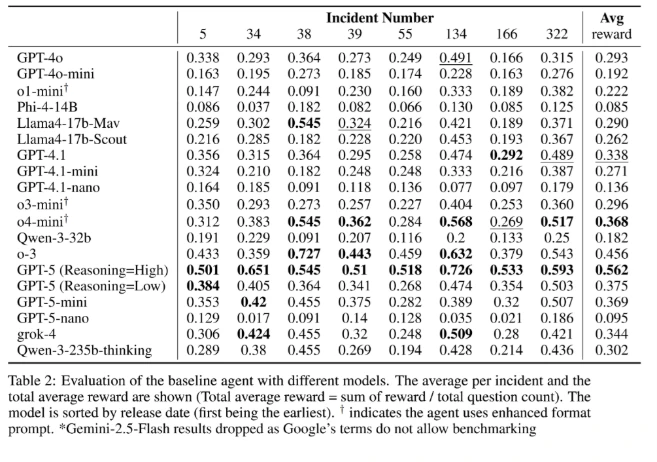
Table comparing average rewards of different AI models across several incidents. GPT-5 (Reasoning=High) shows the highest average reward.
  • GPT-5 (Excessive Reasoning) leads with a 56.2% common reward, outperforming earlier fashions and demonstrating the worth of superior reasoning for safety duties.
  • Smaller fashions with efficient chain-of-thought (CoT) reasoning—like GPT-5-mini—are actually rivaling bigger fashions, providing robust efficiency at decrease value.
  • Express reasoning issues—Decrease reasoning settings in GPT-5 drop efficiency by almost 19%, highlighting that deep, step-by-step reasoning is important for advanced investigations.
  • Open-source fashions are closing the hole with proprietary options, making high-quality safety automation extra accessible.
  • New fashions are getting near prime CoT methods (ReAct, reflection and BoN at 56.3%) however don’t surpass them, suggesting comparable reasoning throughout inference.

Get entangled

ExCyTIn-Bench is open-source and free to entry. Mannequin builders and safety groups are invited to contribute, benchmark, and share outcomes via the official GitHub repository. For questions or partnership alternatives, attain out to the crew at [email protected].

Thanks to the MSECAI Benchmarking crew for serving to this turn into actuality.

To study extra about Microsoft Safety options, go to our web site. Bookmark the Safety weblog to maintain up with our professional protection on safety issues. Additionally, observe us on LinkedIn (Microsoft Safety) and X (@MSFTSecurity) for the most recent information and updates on cybersecurity.


1Benchmarking LLM brokers on Cyber Menace Investigation

2https://huggingface.co/datasets/anandmudgerikar/excytin-bench

3CyberSOCEval: Benchmarking LLMs Capabilities for Malware Evaluation and Menace Intelligence Reasoning

4[2406.07599] CTIBench: A Benchmark for Evaluating LLMs in Cyber Menace Intelligence

5Incident or Menace Investigation graphs painting multi-stage assaults by linking alerts, occasions, and indicators of compromise (IoCs) right into a unified view. Nodes denote alerts (e.g., suspicious file downloads) or entities (e.g., person accounts) whereas edges seize their relationships (e.g., a phishing electronic mail that triggers a malicious obtain)

6[2507.14201] ExCyTIn-Bench: Evaluating LLM brokers on Cyber Menace Investigation 


DJI Chinese language Army Firm designation

0

DJI has filed an enchantment with the U.S. Courtroom of Appeals for the D.C. Circuit following a federal district court docket ruling that upheld the Division of Protection’s designation of the corporate as a “Chinese language Army Firm.” The enchantment marks the most recent step in a authorized course of that has drawn consideration throughout each the drone and protection sectors.

In response to the corporate, the District Courtroom rejected many of the Division of Protection’s allegations, discovering no proof that DJI is owned or managed by the Chinese language Communist Social gathering, affiliated with the Ministry of Business and Info Expertise, or linked to any military-civil fusion enterprise zone. The Courtroom upheld solely two factors, associated to DJI’s Nationwide Enterprise Expertise Middle standing and the dual-use nature of its merchandise, however didn’t conclude that DJI has navy ties.

In an announcement asserting the enchantment, a DJI spokesperson mentioned, “We respect the Courtroom’s course of however are disillusioned that the designation stays in place regardless of findings that reject the core of the DoD’s allegations. We’ll proceed to defend the integrity of our firm because the findings reaffirm what now we have maintained all alongside — that DJI operates independently, has no authorities or navy affiliation, and is dedicated to the accountable improvement of drone expertise.”

The Broader U.S. Coverage Panorama

Inclusion on the Division of Protection listing is one in every of a number of measures the U.S. authorities has applied to restrict the usage of DJI drones. As DRONELIFE beforehand reported, federal businesses are pursuing a twin method to each prohibit Chinese language-manufactured drone platforms and help the expansion of home options.

The Division of Protection designation, alongside different pending laws, has successfully restricted the acquisition and use of DJI merchandise by federal businesses and contractors. On the identical time, U.S. manufacturing initiatives, such because the Blue UAS program and industrial investments supported by the Division of Protection and the Division of Commerce, purpose to strengthen home drone provide chains and scale back reliance on overseas elements.

DJI’s Response and Ongoing Compliance Measures

DJI maintains that it’s a non-public firm devoted to civilian and inventive functions of drone expertise. The corporate famous that it was the primary within the business to publicly discourage the fight use of its merchandise and continues to implement insurance policies prohibiting such use. DJI said that it doesn’t manufacture navy tools and has by no means marketed drones for fight functions.

The end result of the enchantment might form future interpretations of what qualifies as a “Chinese language Army Firm” below U.S. regulation. It can additionally affect how the federal government defines acceptable overseas participation within the American drone market: a market now below intense scrutiny because the U.S. seeks to steadiness nationwide safety issues with the necessity for technological innovation.

Learn extra:


Your information to Day 1 of RoboBusiness 2025

0

Your information to Day 1 of RoboBusiness 2025

RoboBusiness 2025 is lastly right here! The premier occasion for builders and suppliers of economic robots will embrace over 60 audio system, a startup workshop, the annual Pitchfire competitors, and over 100 exhibitors on the present flooring.

The present kicks off at 9:30 a.m. PT with a keynote speak from Deepu Talla, the vice chairman of robotics and edge AI at NVIDIA. His speak, “Bodily AI for the New Period of Robotics,” shall be in the principle theater. Talla will talk about how NVIDIA is accelerating the trade’s transition to bodily AI.

Talla’s keynote shall be adopted by a brief networking break after which by a keynote panel, “Classes Realized From the First Humanoid Deployments,” at 10:30 a.m. This speak will embrace Jim Fan, the director of AI and a distinguished scientist at NVIDIA; Pras Velagapudi, chief expertise officer at Agility Robotics; and Mike Oitzman, senior editor at The Robotic Report.

At 10:00 a.m., the RoboBusiness present flooring will open. There, yow will discover the Engineering Theater, a networking lounge, the Startup Showcase, the MassRobotics Startup Alley, and the KAIST Korean Pavilion. For those who’re curious about choosing up lunch, yow will discover the meals court docket behind the expo corridor.

The day will shut with the RoboBusiness Networking Reception from 5:00 to 7:00 p.m. on the second flooring Pre-function & Terrace.

Day 1 breakout periods

Breakout periods will kick off at 11:30 a.m. In the present day’s RoboBusiness breakout speak schedule is:

  • Constructing the Future in Asia: Singapore as a Hub for Superior Manufacturing and Robotics: This session will begin at 11:30 a.m. in Room 206. Panelists will embrace Chloe Chong, the regional director of Americas at Singapore EDB; Lionel Lim, the vice chairman and head of expertise {hardware} and tools at Singapore EDB; Kai Xin Thia, the top of AI and knowledge analytics at Group Know-how Workplace, ST Engineering; and Desmond Tung, the SGP OFS IM Answer engineering supervisor at Agilent Applied sciences.
  • Evolution of Sensors for Agrobotics: This panel is at 11:30 a.m. in Room 212. It would characteristic Maharajan Veerabahu, co-founder and vice chairman at e-con Programs; Charlie Anderson, the CEO of Burro; Katie Bradford, founder and CEO of Rotate8; Ben Chostner, an advisor on product and firm technique in agriculture; and Russell Nickerson, the partnership engagement liaison at MassRobotics.
  • How Multi-Mannequin Resolution Brokers Enhance Efficiency, Security, Scale: Robert Solar, a founding engineer at Dexterity, will current at 11:30 a.m. in Room 203/204.
  • Humanoids for Actual Purposes: Mastering Security and Efficiency: Nikolai Ensslen, the founder and CEO of Synapticon, will converse at 11:30 a.m. in Room 209/210.
  • Built-in Actuators for Subsequent-Gen Robotics: Energy Density Meets Design Freedom: This session, led by Marcel Almonte, a mechatronics functions engineer at Harmonic Drive, will begin at 11:30 a.m. in Room 207.
  • Classes Realized from Profitable (and Failed) Robotics Initiatives: Dorota Shortell, the CEO of Simplexity Product Improvement, will share her experiences at 11:30 a.m. in Room 201.
  • Developments in Humanoid Actuation: This session with Jordan Schaeffer, a strategic enterprise improvement engineer at Novanta, will start at 1:30 p.m. in Room 212.
  • Constructing Imaginative and prescient Fashions Sooner with Artificial Knowledge: Brian Geisel, the CEO of Geisel Software program & Symage, will discover this subject at 1:30 p.m. in Room 207.
  • How AI Enhances ABB’s Robotic Efficiency: Thomas-Tianwei Wang, the lead AI utility engineer at ABB Robotics, will begin this session at 1:30 p.m. in Room 203/204.
  • Startup Boot Camp Half 1: Fundamentals & Greatest Practices: This panel dialogue will begin at 1:30 p.m. in Room 206. It would characteristic John Lanza, a companion at Foley Hoag LLC; Joyce Sidopoulos, co-founder and chief of operations of MassRobotics, Jennifer Audeh, a companion at Foley Hoag; and Marita McGinn, director of the MassRobotics Accelerator.
  • The Rise of Cell Manipulation: Jan Zizka, co-founder and CEO of Brightpick, will share insights at 1:30 p.m. in Room 201.
  • Advancing Human-Robotic Collaboration By way of Pure Language AI: At 2:30 p.m. in Room 201, see Han-Pang Chiu, the technical director on the Heart for Imaginative and prescient Applied sciences’ Imaginative and prescient and Robotics Laboratory at SRI.
  • Challenges of Constructing Building Robots: This panel at 2:30 p.m. in Room 212 will embrace Mike Oitzman, senior editor at The Robotic Report; Ali Raja, the managing director of automation for industries at ABB Robotics; Kevin Albert, the CEO and co-founder at Canvas; and James Emerick, co-founder and CEO of Cosmic Robotics.
  • Integrating Behavioral Science into Humanoid Design: Ram Devarajulu, the VP and head of robotics at North America at Cambridge Consultants, will converse at 2:30 p.m. in Room 209/210.
  • Defending Innovation in Robotics: IP Methods that Work: This speak will begin at 2:30 p.m. in Room 206. It would embrace observations from Roman Fayerberg, a shareholder and patent lawyer at Greenberg Traurig; Chase Olle, the CEO and founder at Robotic on Rails; and Kartik Tiwari, the co-founder and CTO at Andromeda Surgical.
  • Sim2Real Reinforcement Studying: Coaching Robots for the Actual World: At 2:30 p.m. in Room 203/204, this panel will characteristic specialists Ken Goldberg, the William S. Floyd Jr. Distinguished Chair in Engineering at UC Berkeley, and Jeff Mahler, the co-founder and CTO at Ambi Robotics.
  • A Complete Tour of the Trendy Surgical Robotic Suite: This session will begin at 4:00 p.m. in Room 207. It would embrace James Davison, the VP of engineering at Kollmorgen, and Yoshi Umeno, an trade supervisor of world medical & robotics at Kollmorgen.
  • Making use of Classes from the World’s Largest Autonomous Mining Deployment to Different Markets: Mel Torrie, the CEO at Autonomous Options Inc., will speak at 4:00 p.m. in Room 212.
  • From Teleop to Autonomy: A Framework for Humanoid Surgical Robots: Michael Yip, an affiliate professor of Electrical and Laptop Engineering, affiliate professor of Laptop Science, and Mechanical & Aerospace Engineering at UC San Diego, will current at 4:00 p.m. in Room 209/210.
  • Robotics Startup Boot Camp Half 2: Worldwide Progress – Meet the Founders: This panel, at 4:00 p.m. in Room 206, will embrace Marita McGinn, the director of the MassRobotics Accelerator; Saumik Biswas, founder, CEO, and president of Tenomix; Natalya Lopareva, the co-founder and CEO at Algorized; and Jeongseok Jay Yu, a companion at Foley Hoag.
  • The Generalization Hole: Why Bodily AI Wants Smarter Knowledge Curation: Benji Barash, the co-founder and CEO of Roboto, will begin this session at 4:00 p.m. in Room 203/204.

Engineering Theater schedule

Engineering Theater periods will start on the present flooring at 11:45 a.m. The schedule is:

  • Actual-time Imaginative and prescient AI system on Edge AI platforms: Ravi Dua, the director of engineering at Einfochips, will take the stage at 11:45 a.m.
  • Constructing and Investing in Bodily AI: This panel with Srini Ananth, managing director at Intel Capital; Greg Estes, strategic advisor on the Mayfield Fund; Sed Fakoorian, the founder and CEO of Stealth; and Amulya Vishwanath, co-founder and managing companion at Techable VC, will start at 12:30 p.m.
  • Security With out Stopping: Attaining Security Compliant Operations for Excessive-Density AMR/AGV Fleets with Actual-Time Location Programs: John Calcio, VP of partnerships at Redpoint Positioning, will current at 1:15 p.m.
  • How you can Construct and Scale a Humanoid Firm: Bren Pierce, the CEO at Kinisi Robotics, will share insights at 2:00 p.m.
  • Object Computer systems – Robots with Sentience: Nikhil Ramaswamy, the founder and GTM of gross sales and funding at CynLr, will converse at 2:45 p.m.
  • A New World of Software program-Outlined Robotics, Alternatives and Dangers: This session by Sreedhar Tumma, the worldwide senior product advertising and marketing supervisor at QNX, will begin at 3:30 p.m.

Munich-based Tubulis secures €308 million to advance antibody-drug conjugate innovation

0

German biotech firm Tubulis has raised €308 million in a record-breaking Sequence C funding spherical, marking the most important Sequence C ever closed by a European biotech and the most important financing for a personal antibody-drug conjugate (ADC) developer worldwide. The spherical was led by Venrock Healthcare Capital Companions, with participation from Wellington Administration and Ascenta Capital, alongside current traders together with Nextech Make investments, EQT Life Sciences, Frazier Life Sciences, Andera Companions, Deep Monitor Capital, Bayern Kapital, Fund+, OCCIDENT, Seventure Companions, and HTGF.

Based in Munich, Tubulis specialises in creating uniquely matched ADCs that mix antibodies with potent medication to focus on and destroy most cancers cells with excessive precision. The brand new funding will speed up the medical growth of its lead candidate, TUB-040, which targets NaPi2b, an antigen overexpressed in ovarian and lung cancers. At the moment below analysis in a Section I/IIa examine, TUB-040 acquired Quick Monitor designation from the U.S. FDA in 2024.

The contemporary capital may also advance Tubulis’ broader pipeline, together with TUB-030 and a number of preclinical programmes, in addition to broaden its proprietary ADC platform applied sciences. These improvements goal to unlock new therapeutic prospects and enhance outcomes for sufferers with stable tumours.

“This landmark financing spherical displays the deep conviction these international healthcare traders have in Tubulis and the disruptive potential of our ADC platforms,” mentioned Dr. Dominik Schumacher, CEO and Co-founder of Tubulis. “With TUB-040 progressing within the clinic and first knowledge to be shared in a late-breaking oral presentation at ESMO, we’re able to broaden into earlier remedy strains, whereas persevering with to innovate throughout our pipeline and know-how platforms. The brand new funding empowers us to execute on our imaginative and prescient of making really differentiated antibody-drug conjugates which might be tailor-made to the biology of stable tumours and may ship superior therapeutic worth to sufferers.”

HTGF (Excessive-Tech Gründerfonds), considered one of Tubulis’ earliest backers, renewed and expanded its dedication on this spherical. The investor co-led Tubulis’ Sequence A in 2020 and has supported the corporate from idea to medical growth, underlining Germany’s energy as a biotech innovation hub and its potential to mobilise non-public capital for capital-intensive applied sciences.

“HTGF was considered one of our earliest traders and supported us in shaping Tubulis throughout its early life. Their renewed dedication on this spherical displays the continued partnership and shared perception in our mission to broaden the therapeutic potential of ADCs for sufferers worldwide,” mentioned Dr. Dominik Schumacher, CEO and Co-founder of Tubulis.

Dr. Frank Hensel, Principal at HTGF, added: “Our relationship with Tubulis has at all times been constructed on belief and a shared ambition to redefine oncology remedy. This newest spherical, supported by main international traders, validates the energy of the platform and the workforce. We’re proud to proceed backing Tubulis because it enters a pivotal part of medical growth.”

Dr. Achim Plum, Managing Director at HTGF, mentioned: “Tubulis’ Sequence C demonstrates that even extremely capital-intensive, disruptive applied sciences can appeal to the non-public funding wanted to convey cutting-edge therapies to sufferers. For us at HTGF, Tubulis is a primary instance of how we function: we interact very early, usually earlier than an organization is based, and construct trusted relationships with distinctive groups. This story displays our perception in scientific excellence, entrepreneurial imaginative and prescient, and the affect that may be achieved when each come collectively. Congratulations to your complete Tubulis workforce on this excellent success.”

Tubulis’ breakthrough ADC applied sciences have positioned it as considered one of Europe’s most promising biotech gamers. By combining world-class science, medical progress, and international investor confidence, the corporate continues to advance its mission of increasing the therapeutic potential of ADCs for most cancers sufferers worldwide.


Apple’s New MacBook Leaves the ‘Professional’ and ‘Max’ for Later

0

Apple isn’t fairly able to launch its top-end MacBooks but. However as a pity prize for getting by the terrible yr of 2025, the engineers on Apple’s campus in Cupertino, California, have a brand new MacBook Professional with M5 to tide you over. Higher but, Apple claims this new 14-inch MacBook Professional gives higher battery life than earlier than.

The brand new MacBook Professional seems to be very, similar to final yr’s MacBook Professional with M4. It’s nonetheless utilizing the identical Liquid Retina XDR mini LED show as earlier iterations did. After all, which means it nonetheless has the notch hanging over the display screen, like a guillotine blade on the sting of a horrible descent, to not point out the identical Magic Keyboard design that’s change into normal throughout Mac merchandise. For those who have been hoping we’d lastly obtain the windfall of OLED on Mac, you’ll in all probability have to attend till subsequent yr on the earliest.

Apple Macbook Pro 14 In macOS Tahoe Apple Intelligence Rewrite 251015
© Apple

Apple claims the brand new M5 chip is constructed particularly for AI and graphics efficiency. The brand new model of the M-series silicon consists of new GPU cores, and every is full of a neural accelerator. That is supposed to supply 3.5 instances higher AI efficiency than the earlier era—however let’s be trustworthy, you actually care about the way it will carry out on graphics-intensive duties. The 14-inch MacBook Professional with M5’s 10-core GPU guarantees 1.6 instances sooner graphics efficiency in some inventive apps in comparison with the M4 chip. It ought to have higher multi-thread efficiency for longer workloads, which can profit code compiling or video modifying.

This would be the first MacBook to ship with macOS 26 Tahoe, which implies you’ll must get used to Liquid Glass and adjustments to the Highlight operate sooner reasonably than later. The brand new MacBook Professional begins at $1,600 with 16GB of RAM and 512GB of SSD storage. You’ll have to spend $1,800 for a model with 1TB of storage and a whopping $2,000 for a mannequin with 24GB of RAM. The machine is up for preorder now, and items ought to begin transport Oct. 22, based on Apple. The MacBook is accessible within the ordinary House Black and Silver colours.

Apple Macbook Pro 14 In Gaming Cyberpunk 2077 Ultimate Edition 251015
© Apple

Dependable leakers have prompt {that a} new MacBook Professional, powered by the M5 Professional and M5 Max chips, might come subsequent yr, probably with an upgraded chip design. Intel just lately debuted its Panther Lake cellular chips with a singular design that expands the dimensions of the GPU, or graphics processing unit. Panther Lake makes use of a die-to-die bridge to attach its GPU and CPU, which means the previous may be bigger than it may very well be if the 2 have been housed on the identical die. Maybe Apple is taking an analogous strategy with its upcoming chips. An upgraded GPU would make sense, contemplating that the corporate is pushing gaming on Mac way over it has in earlier years.

No matter delights could also be in retailer for Mac followers in 2026, not less than Apple is signifying that it’s not going to boost the costs of its lower-end fashions, even because it sits within the eye of President Donald Trump’s tariff storm. Subsequent yr, nonetheless, might carry much more hardship to large tech’s provide chains. We’ll must see if the corporate’s present pricing scheme can survive.

Apple’s 2025 iPad Professional comes with an M5 chip inside

0

Apple simply introduced a brand new mannequin of its greatest and highest-end pill, the iPad Professional. The brand new machine comes with a few inner upgrades over the M4-powered mannequin, most notably a brand-new chip, the M5. Apple says the chip brings “as much as 3.5x the AI efficiency” of final yr’s Professional, no matter which means, together with large enhancements in varied video duties.

Apple appears to be positioning the machine as an improve for individuals who purchased M1-powered Professionals or older fashions, moderately than something M4 homeowners needs to be jealous of. However the brand new machine really has a bunch of inner upgrades past simply the brand new processor. The Professional now additionally comes with Apple’s new C1X mobile modem (if you happen to get the mobile model), and the N1 chip for Wi-Fi, Bluetooth, and Thread. (Thread!) Apple elevated learn and write speeds to reminiscence, too, and the Professional even helps quick charging of as much as 50 % in about half-hour.

The 11-inch mannequin begins at $999, and the 13-inch Professional at $1,299. They arrive in two colours, black and silver. Each can be found for pre-order now, and will likely be transport and in shops on October 22.

The final time Apple upgraded the iPad Professional was in Might of 2024, and that machine was an enormous change from what had come earlier than. That Professional got here with a brand new, thinner design, an OLED display screen improve, new equipment, and a much-improved digicam setup. It was additionally the primary machine to run the M4 processor; Apple is seemingly making a behavior out of debuting new chips and new tablets collectively. The M4 Professional has been the most effective pill in the marketplace ever since. It’s a severely costly machine — you’ll be able to spend $2,000 on the factor with out making an attempt very laborious — but it surely’s a wonderful one.

Including much more energy to the iPad Professional is smart, as Apple continues to show the machine into one thing much more like a laptop computer. With iPadOS 26, now you can do nearly free-form multitasking on the iPad, and paired with the (additionally superb) Magic Keyboard accent it might do loads of MacBook issues. We’ve mentioned for years that the iPad’s bleeding-edge {hardware} has been held again by its hand-holding software program, however the platform appears to be opening up increasingly. And as Apple’s basis fashions and different AI options begin to make their approach across the platform, you would possibly really be capable to push the M5 to its limits.

What’s worse than adverts in your TV? Advertisements in your TV that includes you

0

directv shopping copy

TL;DR

  • DirecTV’s Gemini streaming gadgets will quickly present you AI-generated adverts that includes your face.
  • It’s partnering with Look, which is able to use your face to create AI avatars that includes shoppable merchandise, just like Google’s try-on buying characteristic.
  • Look additionally powers lockscreen adverts on telephones from main manufacturers.

The easiest way for many TV producers to extract worth from shoppers is to show adverts. So why not take it up a notch with customized concentrating on? Or take it a step additional by displaying your digital clones on-screen to promote appropriate merchandise? That’s precisely what the US-based streaming {hardware} and repair supplier DirecTV goals to do with its newest improvement.

The streaming big says the options are coming to its Gemini (to not be confused with Google’s Gemini AI) vary of gadgets in 2026. The so-called “AI-powered content material and commerce screensavers” are powered by Look, the identical platform that powers lock display adverts on practically each main Android cellphone model, whereas labelling them as “wallpaper providers.” Look’s screensaver adverts exist already on different Android-based streaming gadgets, together with ones provided by Airtel in India, the place it’s already utilizing AI to generate a part of these screensaver adverts.

Don’t wish to miss the most effective from Android Authority?

google preferred source badge light@2xgoogle preferred source badge dark@2x

In DirecTV’s case, Look will present you photos of sure merchandise, together with a QR code you may scan along with your cellphone to add them, The Verge studies. Additionally, you will have the choice to insert a number of photographs to create a 30-second AI-generated spotlight video. Nevertheless, not like Google, which creates digital avatars from precise merchandise, Look will solely present AI-generated merchandise which are comparable. Should you like a glance, it’ll carry out a reverse search to match precise merchandise in its database, prompting you to finish the transaction in your cellphone.

As well as, Gemini streaming {hardware} may even show interactive adverts from completely different classes, together with auto, native occasions and traits, well being, way of life, and journey, based mostly in your pursuits — presumably utilizing your watch historical past.

The DirecTV interface for large screens isn’t the one platform to characteristic customized AI-generated adverts. Earlier this 12 months, Look partnered with Samsung to show AI-generated variations of you dressed up in several outfits in your cellphone’s lock display. Happily, not less than in Samsung’s case, these can be found solely on an opt-in (not opt-out) foundation.

It’s unclear the place it stands with DirecTV, however Look has already hinted at its plans to increase it to different surfaces, together with the launcher.

Thanks for being a part of our group. Learn our Remark Coverage earlier than posting.