

LLMs like these from Google and OpenAI have proven unimaginable talents. However their energy comes at a value. These large fashions are sluggish, costly to run, and troublesome to deploy on on a regular basis units. That is the place LLM compression methods are available in. These strategies shrink fashions, making them quicker and extra accessible and not using a main loss in efficiency. This information explores 4 key methods: mannequin quantization, mannequin pruning strategies, information distillation in LLMs, and Low-Rank Adaptation (LoRA), full with hands-on code examples.
Why Do We Want LLM Compression?
Earlier than diving into the “how,” let’s perceive the “why.” Compressing LLMs presents clear benefits that make them sensible for real-world use.
- Lowered Mannequin Measurement: Smaller fashions require much less storage, making them simpler to host and distribute.
- Quicker Inference: A compact mannequin can generate responses extra shortly. This improves the person expertise in functions like chatbots.
- Decrease Prices: Lowered measurement and quicker velocity result in decrease wants for reminiscence and processing energy. This cuts down on cloud computing and power prices.
- Better Accessibility: Compression permits highly effective fashions to run on units with restricted sources, like smartphones and laptops.
Method 1: Quantization – Doing Extra with Much less
Mannequin quantization is likely one of the hottest and efficient LLM compression methods. It really works by lowering the precision of the numbers (weights) that make up the mannequin. Consider it like saving a high-resolution picture as a compressed JPEG; you lose a tiny quantity of element, however the file measurement shrinks dramatically. Most fashions are skilled utilizing 32-bit floating-point numbers (FP32). Quantization converts these to smaller 8-bit integers (INT8) and even 4-bit integers.
This picture visually explains quantization, the place steady, high-precision FP32 (32-bit floating-point) values are mapped to a restricted set of discrete, lower-precision INT4 (4-bit integer) values. Basically, it reveals how a variety of floating-point numbers are approximated by a smaller, mounted variety of integer ranges to cut back reminiscence and computation, although this could introduce some precision loss.
Arms-On: 4-bit Quantization with Hugging Face
Let’s quantize a mannequin utilizing the Hugging Face transformers and bitsandbytes library. This instance reveals learn how to load a mannequin in 4-bit precision, considerably lowering its reminiscence footprint.
Step 1: Set up Libraries
First, guarantee you’ve got the required libraries put in.
!pip set up transformers torch speed up bitsandbytes -qStep 2: Load and Examine Fashions
We are going to load a normal mannequin after which its quantized model to see the distinction.
import torch from transformers import AutoModelForCausalLM, AutoTokenizer # We use a smaller, well-known mannequin for this demonstration model_id = "gpt2" print(f"Loading tokenizer for mannequin: {model_id}") tokenizer = AutoTokenizer.from_pretrained(model_id) print("n-----------------------------------") print("Loading authentic mannequin in FP32...") # Load the unique mannequin in full precision (Float32) model_fp32 = AutoModelForCausalLM.from_pretrained(model_id) # Examine the reminiscence footprint of the unique mannequin print("nOriginal mannequin reminiscence footprint:") # Calculate reminiscence footprint manually mem_fp32 = sum(p.numel() * p.element_size() for p in model_fp32.parameters()) print(f"{mem_fp32 / 1024**2:.2f} MB") print("n-----------------------------------") print("Loading mannequin with 4-bit quantization...") # Load the identical mannequin with 4-bit quantization enabled model_4bit = AutoModelForCausalLM.from_pretrained( model_id, load_in_4bit=True, device_map="auto" # Robotically makes use of the GPU if obtainable ) # Examine the reminiscence footprint of the 4-bit mannequin print("n4-bit quantized mannequin reminiscence footprint:") # Calculate reminiscence footprint manually mem_4bit = sum(p.numel() * p.element_size() for p in model_4bit.parameters()) print(f"{mem_4bit / 1024**2:.2f} MB") print("nNotice the numerous discount in reminiscence utilization!")Output:
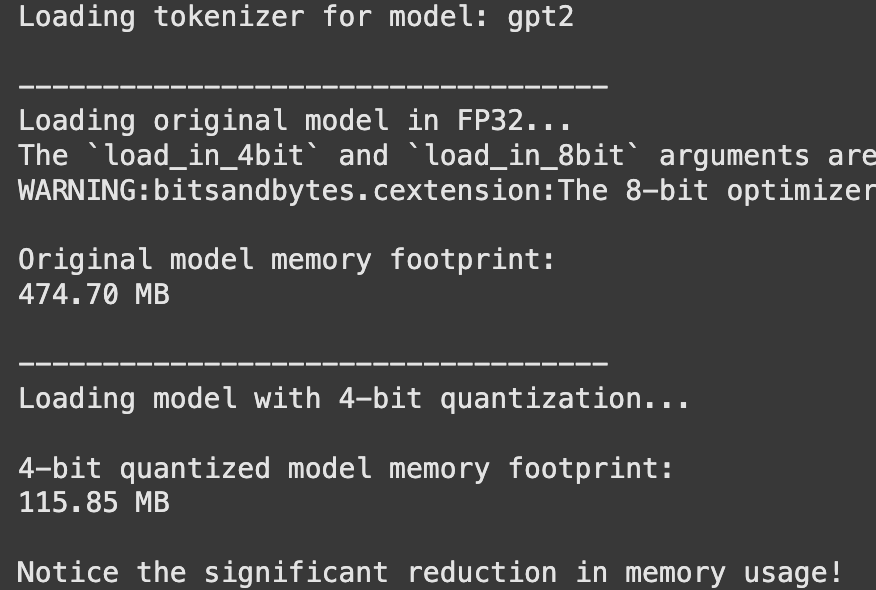
You’ll discover a major discount within the mannequin’s reminiscence utilization with nearly no change to the standard of its output for many duties.
Method 2: Pruning – Trimming Away Unused Connections
Mannequin pruning strategies work by eradicating elements of the neural community that contribute the least to its output. It’s like trimming a plant to encourage more healthy progress. You may take away particular person weights (unstructured pruning) or total teams of neurons (structured pruning). Whereas highly effective, pruning will be advanced to implement appropriately.
Unstructured pruning, for example, removes particular person weights based mostly on their magnitude, making a sparse mannequin. Whereas this makes the mannequin smaller, it may be troublesome for {hardware} to make the most of the sparse construction. Structured pruning removes total blocks, like neurons or layers, which is commonly extra hardware-friendly.
The picture illustrates totally different methods for pruning elements just like the Imaginative and prescient Transformer (ViT) and the Giant Language Mannequin (LLM) utilizing “pruning layers” to cut back mannequin measurement and enhance effectivity. Particularly, (a) reveals pruning within the visible encoder, (b) focuses on pruning throughout the LLM, and (c) introduces an “instruction-guided element” to dynamically prune visible tokens based mostly on textual directions, enhancing effectivity for duties like video understanding.
Method 3: Information Distillation – The Scholar-Instructor Strategy
Information distillation in LLMs is an enchanting course of. A big, extremely correct “trainer” mannequin trains a smaller “pupil” mannequin. The coed learns to imitate the trainer’s thought course of (its output possibilities), not simply the ultimate reply. This enables the smaller mannequin to attain efficiency far past what it might by coaching on the information alone.
This picture illustrates three information distillation strategies in machine studying: offline, on-line, and self-distillation. Offline distillation makes use of a pre-trained “trainer” to coach a “pupil”, whereas on-line distillation trains each concurrently, and self-distillation entails a single mannequin appearing as each trainer and pupil (e.g., deeper layers instructing shallower ones). The orange “trainer” fashions are pre-trained, whereas the blue “pupil” fashions (together with the mixed “trainer/pupil” in self-distillation) are “to be skilled”.
Arms-On: Conceptual Distillation with Hugging Face
Implementing a full distillation pipeline is concerned, however the core concept will be understood by way of the Hugging Face Coach API.
from transformers import TrainingArguments, Coach # This can be a conceptual instance as an instance the method. # To run this, you would want: # 1. An outlined 'teacher_model' (a big, pre-trained mannequin). # 2. An outlined 'student_model' (a smaller mannequin to be skilled). # 3. A 'your_dataset' object for coaching. # Outline Coaching Arguments training_args = TrainingArguments( output_dir="./student_model_distilled", num_train_epochs=1, # Instance worth per_device_train_batch_size=8, # Instance worth # ... different coaching arguments ) # Create a customized Coach to change the loss perform class DistillationTrainer(Coach): def compute_loss(self, mannequin, inputs, return_outputs=False): # That is the core of information distillation. # The loss perform is a weighted common of two elements: # a) The coed's normal loss on the information (e.g., Cross-Entropy). # b) The distillation loss, which measures how nicely the scholar's # output distribution matches the trainer's. # This half is conceptual and requires a full implementation. print("Inside customized compute_loss - that is the place distillation logic would go.") # For instance: # student_outputs = mannequin(**inputs) # student_loss = student_outputs.loss # with torch.no_grad(): # teacher_outputs = teacher_model(**inputs) # distillation_loss = some_kl_divergence_loss(student_outputs.logits, teacher_outputs.logits) # combined_loss = 0.5 * student_loss + 0.5 * distillation_loss # Returning a dummy loss to forestall errors on this conceptual instance dummy_outputs = mannequin(**inputs) return (dummy_outputs.loss, dummy_outputs) if return_outputs else dummy_outputs.loss print("The DistillationTrainer class is outlined conceptually.") print("A full implementation would require a trainer mannequin, pupil mannequin, and a dataset.")This course of successfully transfers the “information” from the big mannequin to the smaller one.
Method 4: Low-Rank Adaptation (LoRA) – Environment friendly High quality-Tuning
Whereas not a way to shrink a base mannequin, Low-Rank Adaptation (LoRA) is a way to compress the adjustments made throughout fine-tuning. As a substitute of retraining all of the billions of parameters in a mannequin, LoRA freezes the unique mannequin and injects tiny, trainable “adapter” layers. These adapters are a lot smaller, making the fine-tuning course of quicker and the ensuing fine-tuned mannequin far more memory-efficient to retailer and swap between.
This diagram explains LoRA (Low-Rank Adaptation) for environment friendly mannequin fine-tuning: throughout coaching, a small, trainable low-rank adaptation matrix (BA) is added to the frozen pretrained weights (W). After coaching, this low-rank matrix is merged with the unique weights, successfully making a specialised mannequin (W + BA) with out rising inference latency or reminiscence footprint throughout deployment. This considerably reduces computational sources and storage necessities in comparison with full fine-tuning.
Arms-On: High quality-Tuning with LoRA and PEFT
The Hugging Face PEFT (Parameter-Environment friendly High quality-Tuning) library makes making use of LoRA easy.
Step 1: Set up Libraries
!pip set up peft -q Step 2: Apply LoRA and Examine Parameter Counts
from peft import get_peft_model, LoraConfig, TaskType from transformers import AutoModelForCausalLM model_id = "gpt2" mannequin = AutoModelForCausalLM.from_pretrained(model_id) # Outline the LoRA configuration lora_config = LoraConfig( task_type=TaskType.CAUSAL_LM, # Specify the duty kind r=8, # Rank of the replace matrices. Decrease rank means fewer parameters. lora_alpha=32, # A scaling issue for the realized weights. lora_dropout=0.1, # Dropout likelihood for LoRA layers. target_modules=["c_attn"] # Apply LoRA to the eye layers of GPT-2. ) # Wrap the bottom mannequin with the LoRA adapters lora_model = get_peft_model(mannequin, lora_config) print("--- Authentic Mannequin ---") # Get the whole variety of parameters for the unique mannequin total_params = sum(p.numel() for p in mannequin.parameters()) print(f"Whole parameters: {total_params:,}") print("n--- LoRA Tailored Mannequin ---") # The PeftModel object has the print_trainable_parameters methodology lora_model.print_trainable_parameters() print("nNote how LoRA reduces trainable parameters by over 99%!") print("This makes fine-tuning far more environment friendly.")Output:
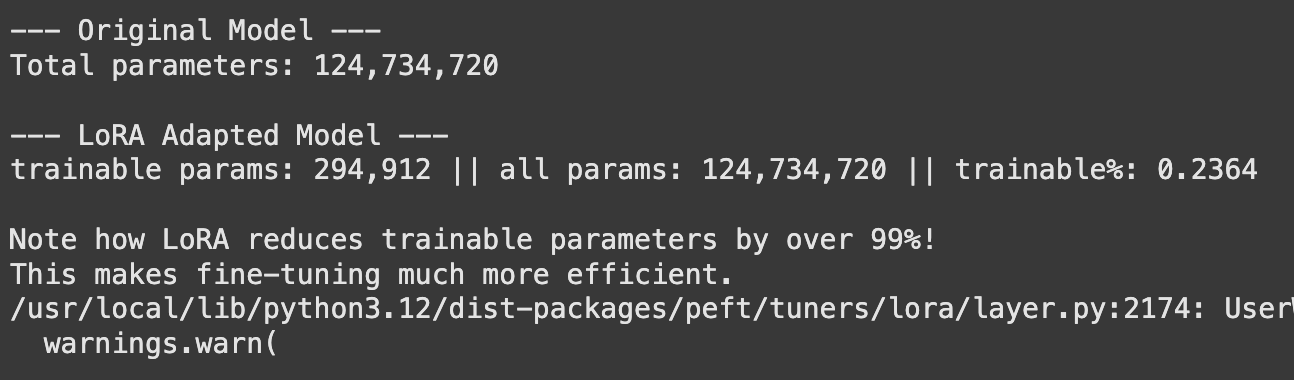
The output will present a dramatic discount (typically over 99%) within the variety of parameters that should be skilled and saved. This makes it attainable to fine-tune and handle many various variations of a mannequin for numerous duties with out storing big mannequin recordsdata for each.
Yow will discover the complete Colab pocket book right here: Colab
Conclusion
Giant Language Fashions are right here to remain, however their large measurement presents an actual problem. LLM compression methods are the important thing to unlocking their potential for a wider vary of functions. Whether or not it’s the easy strategy of mannequin quantization, the surgical precision of mannequin pruning strategies, the intelligent mentorship of information distillation in LLMs, or the effectivity of Low-Rank Adaptation (LoRA), these strategies make AI extra sensible. The best approach is determined by your particular wants, however combining them can typically result in the perfect outcomes.
Ceaselessly Requested Questions
A. Mannequin quantization, particularly Submit-Coaching Quantization (PTQ), is usually the simplest. Libraries like bitsandbytes will let you load a quantized mannequin with a single line of code.
A. It could possibly barely cut back accuracy, however for a lot of functions, the loss is minimal and infrequently unnoticeable. Methods like Quantization-Conscious Coaching (QAT) can assist protect accuracy even additional.
A. Sure, and it’s typically really helpful. A standard and efficient workflow is to first prune a mannequin, then quantize the end result, and use information distillation to fine-tune and get well any misplaced efficiency.
A. Pruning removes total connections (weights) from the mannequin, making it sparser. Quantization reduces the numerical precision of all weights with out altering the mannequin’s structure.
A. LoRA doesn’t shrink the unique base mannequin. As a substitute, it compresses the adaptation or fine-tuning course of, permitting you to create light-weight, task-specific mannequin variations which can be a lot smaller than the unique.

Harsh Mishra is an AI/ML Engineer who spends extra time speaking to Giant Language Fashions than precise people. Captivated with GenAI, NLP, and making machines smarter (so that they don’t change him simply but). When not optimizing fashions, he’s in all probability optimizing his espresso consumption. 🚀☕
Login to proceed studying and luxuriate in expert-curated content material.