


Synthetic intelligence (AI) has shifted from a daring experiment to a strategic necessity. Latest research present that 88% of C-level decision-makers need to speed up AI adoption in 2025. But, only a fraction of AI initiatives delivers the anticipated outcomes.
Conventional AI fashions demand huge, meticulously labeled datasets. For a lot of organizations, gathering, cleansing, and annotating such volumes is prohibitively costly, time-consuming, and even unattainable resulting from information shortage or privateness restrictions. These bottlenecks delay deployment and drive up prices.
That is the place few-shot studying (FSL) presents a breakthrough. By enabling fashions to study new duties from solely a handful of examples, FSL bypasses the heavy information necessities of conventional AI, reworking what has lengthy been a roadblock into a bonus.
On this article, ITRex AI consultants clarify what few-shot studying is and the way firms can use it to facilitate AI deployment and scaling.
What’s few-shot studying, and why do you have to care?
The few-shot studying method displays the best way people study. Folks don’t have to see tons of of examples to acknowledge one thing new – just a few well-chosen situations typically suffice.
Few-shot studying definition
So, what’s few-shot studying?
Few-shot studying, defined in easy phrases, is a technique in AI that permits fashions to study new duties or acknowledge new patterns from just a few examples. Typically as few as two to 5. In contrast to conventional machine studying, which requires hundreds of labeled information factors to carry out properly, few-shot studying considerably reduces the dependency on massive, curated datasets.
Press enter or click on to view picture in full dimension
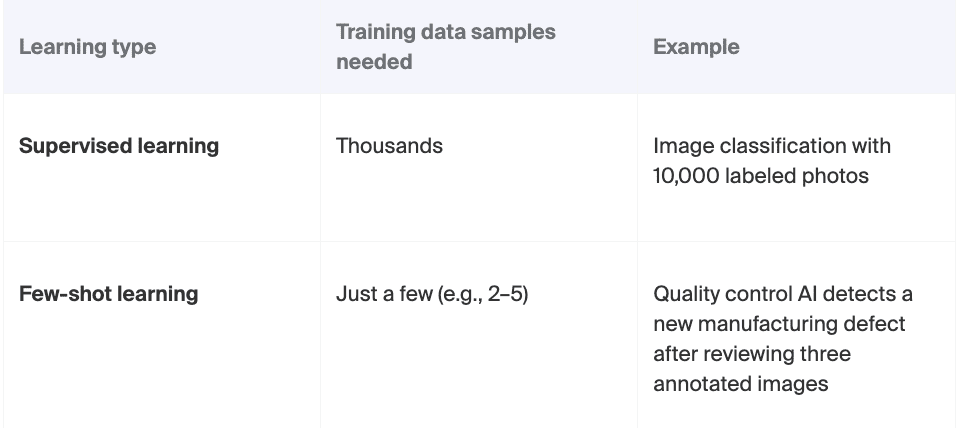
Let’s take a enterprise analogy of speedy onboarding. A seasoned worker adapts rapidly to a brand new position. You don’t have to ship them by means of months of coaching. Simply present them just a few workflows, introduce the precise context, they usually start delivering outcomes. Few-shot studying applies the identical precept to AI, permitting programs to soak up restricted steering and nonetheless produce significant, correct outcomes.
What are some great benefits of few-shot studying?
Few-shot studying does greater than improve AI efficiency – it adjustments the economics of AI fully. It’s a wise lever for leaders centered on velocity, financial savings, and staying forward. FSL will:
- Lower prices with out minimizing capabilities. Few-shot studying slashes the necessity for giant, labeled datasets, which is commonly one of the costly and time-consuming steps in AI tasks. By minimizing information assortment and guide annotation, firms redirect that funds towards innovation as a substitute of infrastructure.
- Speed up deployment and time to market. FSL allows groups to construct and deploy fashions in days, not months. As a substitute of ready for excellent datasets, AI builders present the mannequin just a few examples, and it will get to work. This implies firms can roll out new AI-driven options, instruments, or providers rapidly – precisely when the market calls for it.
For instance, few-shot studying strategies diminished the time wanted to coach a generative AI mannequin by 85%. - Improve adaptability and generalization. Markets shift and information evolves. Few-shot studying allows companies to maintain up with these sudden adjustments. This studying method doesn’t depend on fixed retraining. It helps fashions adapt to new classes or sudden inputs with minimal effort.
How does few-shot studying work?
Few-shot studying is applied otherwise for traditional AI and generative AI with massive language fashions (LLMs).
Few-shot studying in basic AI
In basic AI, fashions are first skilled on a broad vary of duties to construct a common function understanding. When launched to a brand new job, they use only a few labeled examples (the help set) to adapt rapidly with out full retraining.
- Pre-training for common information. The mannequin first trains on a broad, numerous dataset, studying patterns, relationships, and options throughout many domains. This basis equips it to acknowledge ideas and adapt with out ranging from scratch every time.
- Speedy job adaptation. When confronted with a brand new job, the mannequin receives a small set of labeled examples – the help set. The mannequin depends on its prior coaching to generalize from this minimal information and make correct predictions on new inputs, refining its means with every iteration. As an illustration, if an AI has been skilled on varied animal photographs, FSL would enable it to rapidly determine a brand new, uncommon species after seeing only a handful of its pictures, with no need hundreds of latest examples.
Press enter or click on to view picture in full dimension

Few-shot studying replaces the sluggish, data-heavy cycle of conventional AI coaching with an agile, resource-efficient method. FSL for traditional AI typically depends on meta-learning or metric-based strategies.
- Meta-learning – typically referred to as “studying to study” – trains fashions to adapt quickly to new duties utilizing just a few examples. As a substitute of optimizing for a single job, the mannequin learns throughout many small duties throughout coaching, creating methods for fast adaptation.
- Metric-based approaches classify new inputs by measuring their similarity to a couple labeled examples within the help set. As a substitute of retraining a fancy mannequin, these strategies concentrate on studying a illustration area the place associated objects are shut collectively and unrelated objects are far aside. The mannequin transforms inputs into embeddings (numerical vectors) and compares them utilizing a similarity metric (e.g., cosine similarity, Euclidean distance).
Few-shot studying in LLMs
In LLMs, few-shot studying typically takes the type of few-shot prompting. As a substitute of retraining, you information the mannequin’s habits by together with just a few task-specific examples immediately within the immediate.
As an illustration, if you would like the mannequin to generate product descriptions in a selected model, you embrace two to 5 instance descriptions within the immediate together with the request for a brand new one. The mannequin then mimics the model, tone, and format.
Few-shot vs. one-shot vs. zero-shot studying: key variations
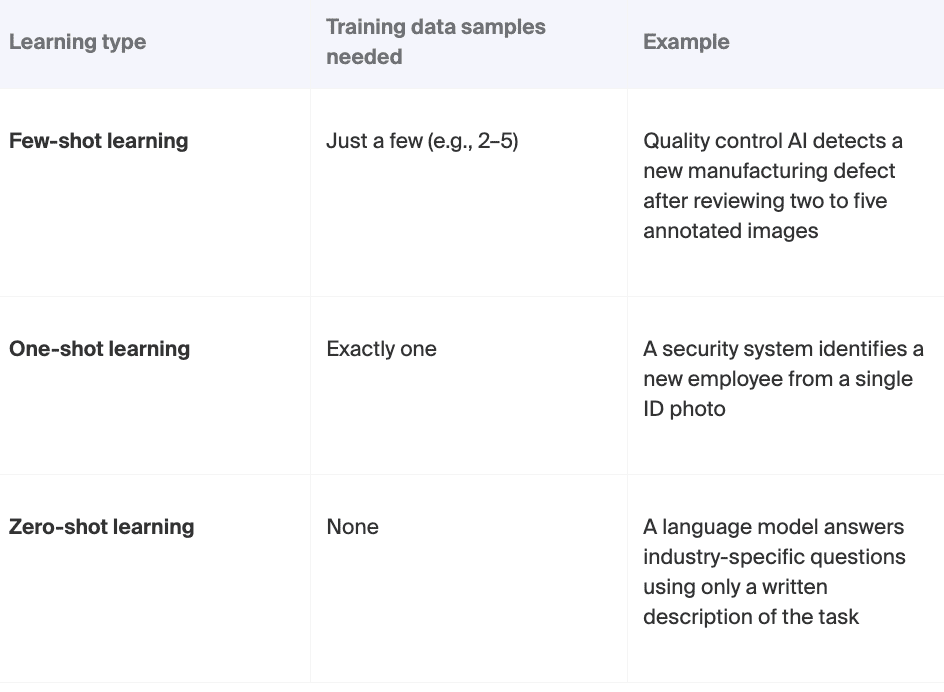
Along with few-shot studying, firms may use one-shot and zero-shot studying. Every presents distinctive methods to deploy AI when information availability is restricted. Understanding their variations is essential to matching the precise method to your small business wants.
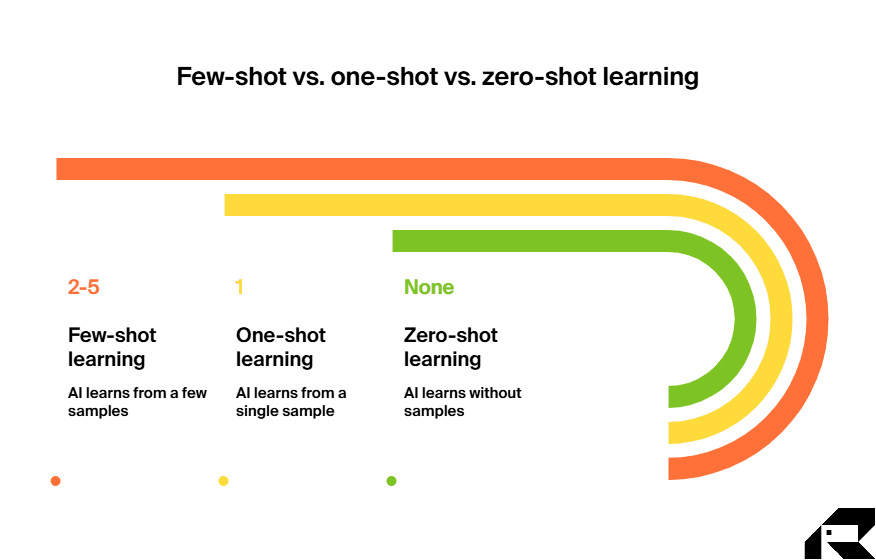
- Few-shot studying. The mannequin learns from a small set of labeled examples (usually 2-5). Perfect when you’ll be able to present some consultant information for a brand new product, course of, or class however need to keep away from the time and price of amassing hundreds of samples.
- One-shot studying. The mannequin learns from precisely one labeled instance per class. That is well-suited for situations the place classes change typically or examples are arduous to acquire.
- Zero-shot studying. The mannequin learns with none task-specific examples. It depends solely on its prior coaching and an outline of the duty. Zero-shot is efficacious when there isn’t any information out there in any respect, but fast deployment is crucial.
Press enter or click on to view picture in full dimension
Press enter or click on to view picture in full dimension
When to keep away from few-shot studying?
Few-shot studying presents velocity and effectivity, however it isn’t all the time the optimum alternative. In some circumstances, fine-tuning or conventional supervised studying will ship extra dependable outcomes. These circumstances embrace:
- When precision is essential. If the duty calls for near-perfect accuracy, similar to in essential medical diagnostics or fraud detection, counting on just a few examples might introduce unacceptable error charges. Advantageous-tuning with a bigger, task-specific dataset offers larger management and consistency.
- When information is available and reasonably priced. In case your group can simply gather and label hundreds of examples, conventional supervised studying might yield stronger efficiency, particularly for complicated or nuanced duties the place broad variability have to be captured.
- When the duty is very domain-specific. Few-shot fashions excel at generalization, however area of interest domains with distinctive terminology, codecs, or patterns typically profit from focused fine-tuning. As an illustration, a authorized AI assistant working with patent filings should interpret extremely specialised vocabulary and doc buildings. Advantageous-tuning on a big corpus of patent paperwork will ship higher outcomes than counting on just a few illustrative examples.
- When the output have to be steady over time. Few-shot studying thrives in dynamic environments, but when your system is steady and unlikely to vary, like a barcode recognition system, investing in a totally skilled, specialised mannequin is a more sensible choice.
Actual-world examples: few-shot studying in motion
Let’s discover the completely different use circumstances of few-shot studying in enterprise AI and enterprise purposes.
Few-shot studying in manufacturing
Few-shot studying accelerates manufacturing high quality management by enabling AI fashions to detect new product variations or defects from only a handful of examples. Additionally, when factories produce extremely personalized or limited-edition merchandise, few-shot studying can rapidly adapt AI programs for sorting, labeling, or meeting duties with minimal retraining, which is good for brief manufacturing runs or speedy design adjustments.
Few-shot studying instance in manufacturing
Philips Client Way of life BV has utilized few-shot studying to rework high quality management in manufacturing, specializing in defect detection with minimal labeled information. As a substitute of amassing hundreds of annotated examples, researchers practice fashions on only one to 5 samples per defect sort. They improve accuracy by combining these few labeled photographs with anomaly maps generated from unlabeled information, making a hybrid technique that strengthens the mannequin’s means to identify faulty parts.
This technique delivers efficiency akin to conventional supervised fashions whereas drastically decreasing the time, price, and energy of dataset creation. It permits Philips to adapt its detection programs quickly to new defect varieties with out overhauling total pipelines.
Few-shot studying in schooling
This studying method permits instructional AI fashions to adapt to new topics, educating kinds, and scholar wants with out the heavy information necessities of conventional AI fashions. Few-shot studying can personalize studying paths primarily based on only a handful of examples, bettering content material relevance and engagement whereas decreasing the time wanted to create personalized supplies. Built-in into real-time studying platforms, FSL can rapidly incorporate new subjects or evaluation varieties.
Past personalised instruction, instructional establishments use FSL to streamline administrative processes and improve adaptive testing, boosting effectivity throughout tutorial and operational capabilities.
Few-shot studying instance from the ITRex portfolio
ITRex constructed a Gen AI-powered gross sales coaching platform to automate onboarding. This answer transforms inside paperwork, together with presentation slides, PDFs, and audio, into personalised classes and quizzes.
Our generative AI builders used an LLM that will examine the out there firm materials, factoring in a brand new rent’s expertise, {qualifications}, and studying preferences to generate a personalized examine plan. We utilized few-shot studying to allow the mannequin to supply personalized programs.
Our workforce supplied the LLM with a small set of pattern course designs for various worker profiles. For instance, one template confirmed how one can construction coaching for a novice gross sales consultant preferring a gamified studying expertise, whereas one other demonstrated a plan for an skilled rent choosing a conventional format.
With few-shot studying, we diminished the coaching cycle from three weeks with basic fine-tuning to only a few hours.
Few-shot studying in finance and banking
Few-shot studying allows speedy adaptation to new fraud patterns with out prolonged retraining, bettering detection accuracy and decreasing false positives that disrupt clients and drive up prices. Built-in into real-time programs, it will probably rapidly add new fraud prototypes whereas holding transaction scoring quick, particularly when mixed with rule-based checks for stability.
Past fraud prevention, banks additionally use few-shot studying to streamline doc processing, automate compliance checks, and deal with different administrative duties, boosting effectivity throughout operations.
Few-shot studying instance in finance:
The Indian subsidiary of Hitachi deployed few-shot studying to coach its doc processing fashions on over 50 completely different financial institution assertion codecs. These fashions are at present processing over 36,000 financial institution statements monthly and preserve a 99% accuracy stage.
Equally, Grid Finance used few-shot studying to show its fashions to extract key revenue information from numerous codecs of financial institution statements and payslips, enabling constant and correct outcomes throughout various doc varieties.
Addressing government considerations: mitigating dangers and guaranteeing ROI
Whereas few-shot studying presents velocity, effectivity, and suppleness, it additionally brings particular challenges that may have an effect on efficiency and return on funding. Understanding these dangers and addressing them with focused methods is crucial for translating FSL’s potential into measurable, sustainable enterprise worth.
Challenges and limitations of few-shot studying embrace:
- Information high quality as a strategic precedence. Few-shot studying reduces the quantity of coaching information required, nevertheless it will increase the significance of choosing high-quality, consultant examples. A small set of poor inputs can result in weak outcomes. This shifts an organization’s information technique from amassing every thing to curating solely probably the most related samples. It means investing in disciplined information governance, rigorous high quality management, and cautious collection of the essential few examples that can form mannequin efficiency and cut back the chance of overfitting.
- Moral AI and bias mitigation. Few-shot studying delivers velocity and effectivity, however it will probably additionally carry ahead biases embedded within the massive pre-trained fashions it depends upon. AI engineers ought to deal with accountable AI governance as a precedence, implementing bias testing, diversifying coaching information the place potential, and guaranteeing transparency in decision-making. This safeguards in opposition to misuse and ensures FSL’s advantages are realized in a good, explainable, and accountable approach.
- Optimizing the “few” examples. In few-shot studying, success hinges on selecting the correct examples. Take too few, and the mannequin underfits – studying too little to generalize. Poorly chosen or noisy examples could cause overfitting and degrade efficiency. So, deal with choice as a strategic step. Use area consultants to curate consultant samples and validate them by means of fast experiments. Pair human perception with automated information evaluation to determine examples that really seize the variety and nuances of the duty.
- Sensitivity to immediate high quality (few-shot studying for LLMs). In LLM-based few-shot studying, the immediate determines the result. Properly-crafted prompts information the mannequin to supply related, correct responses. Poorly designed ones result in inconsistency or errors. Deal with immediate creation as a essential talent. Contain area consultants to make sure prompts mirror actual enterprise wants, and check them iteratively to refine wording, construction, and context.
- Managing computational calls for. Few-shot studying reduces information preparation prices, nevertheless it nonetheless depends on massive, pre-trained fashions that may be computationally intensive, particularly when scaled throughout the enterprise. To maintain tasks environment friendly, plan early for the required infrastructure – from high-performance GPUs to distributed processing frameworks – and monitor useful resource utilization intently. Optimize mannequin dimension and coaching pipelines to steadiness efficiency with price, and discover strategies like mannequin distillation or parameter-efficient fine-tuning to scale back compute load with out sacrificing accuracy.
Few-shot studying: AI’s path to agile intelligence
Few-shot studying presents a wiser approach for companies to make use of AI, particularly when information is scarce or must adapt rapidly. It’s not a magic answer however a sensible instrument that may enhance effectivity, cut back prices, and assist groups reply quicker to new challenges. For leaders trying to keep forward, understanding the place and how one can apply FSL could make an actual distinction.
Implementing AI successfully requires the precise experience. At ITRex, we’ve labored with firms throughout industries, similar to healthcare, finance, and manufacturing, to construct AI options that work – with out pointless complexity. When you’re exploring how few-shot studying might match into your technique, we’d be comfortable to share what we’ve realized.
Typically the most effective subsequent step is only a dialog.
FAQs
How is few-shot studying completely different from zero-shot studying?
Few-shot studying adapts a mannequin to a brand new job utilizing a handful of labeled examples, permitting it to generalize primarily based on each prior coaching and these task-specific samples. Zero-shot studying, in contrast, provides the mannequin no examples in any respect – solely an outline of the duty – and depends fully on its pre-existing information. Few-shot usually delivers larger accuracy when even a small quantity of related information is offered, whereas zero-shot is helpful when no examples exist.
How does few-shot studying enhance massive language fashions?
In LLMs, few-shot studying takes the type of few-shot prompting. By embedding just a few rigorously chosen input-output examples within the immediate, you information the mannequin’s reasoning, format, and tone for the duty at hand. This improves consistency, reduces ambiguity, and helps the LLM align extra intently with enterprise necessities with out retraining or fine-tuning.
How do you create efficient few-shot studying prompts?
Efficient prompts are concise, related, and consultant of the duty. Embody a small set of high-quality examples that cowl the vary of anticipated inputs and outputs. Preserve formatting constant, use clear directions, and check variations to search out the construction that yields probably the most correct outcomes. In high-stakes enterprise contexts, contain area consultants to make sure examples mirror real-world use circumstances and terminology.
Why is few-shot studying essential for adapting AI fashions?
Few-shot studying permits fashions to regulate to new classes, codecs, or patterns rapidly – typically in hours as a substitute of weeks. This agility is essential for responding to evolving markets, altering buyer wants, or rising dangers with out the price and delay of full-scale retraining. It allows organizations to increase AI capabilities into new areas whereas holding operational momentum.
How does few-shot studying cut back the necessity for giant coaching datasets?
FSL leverages the final information a mannequin has acquired throughout pre-training and makes use of just a few task-specific examples to bridge the hole to the brand new job. This eliminates the necessity for large, absolutely labeled datasets, chopping down information assortment, cleansing, and annotation prices. The result’s quicker deployment, decrease useful resource consumption, and a extra favorable ROI on AI initiatives.
Initially revealed at https://itrexgroup.com on August 26, 2025.
;